Rules of the road
Sharing the road with cyclists, pedestrians, motorcycles and trucks
Four kinds of road user, four different ways drivers hurt them, and the one habit that prevents each. Drawn out, with the mirrors and the space you cannot see.
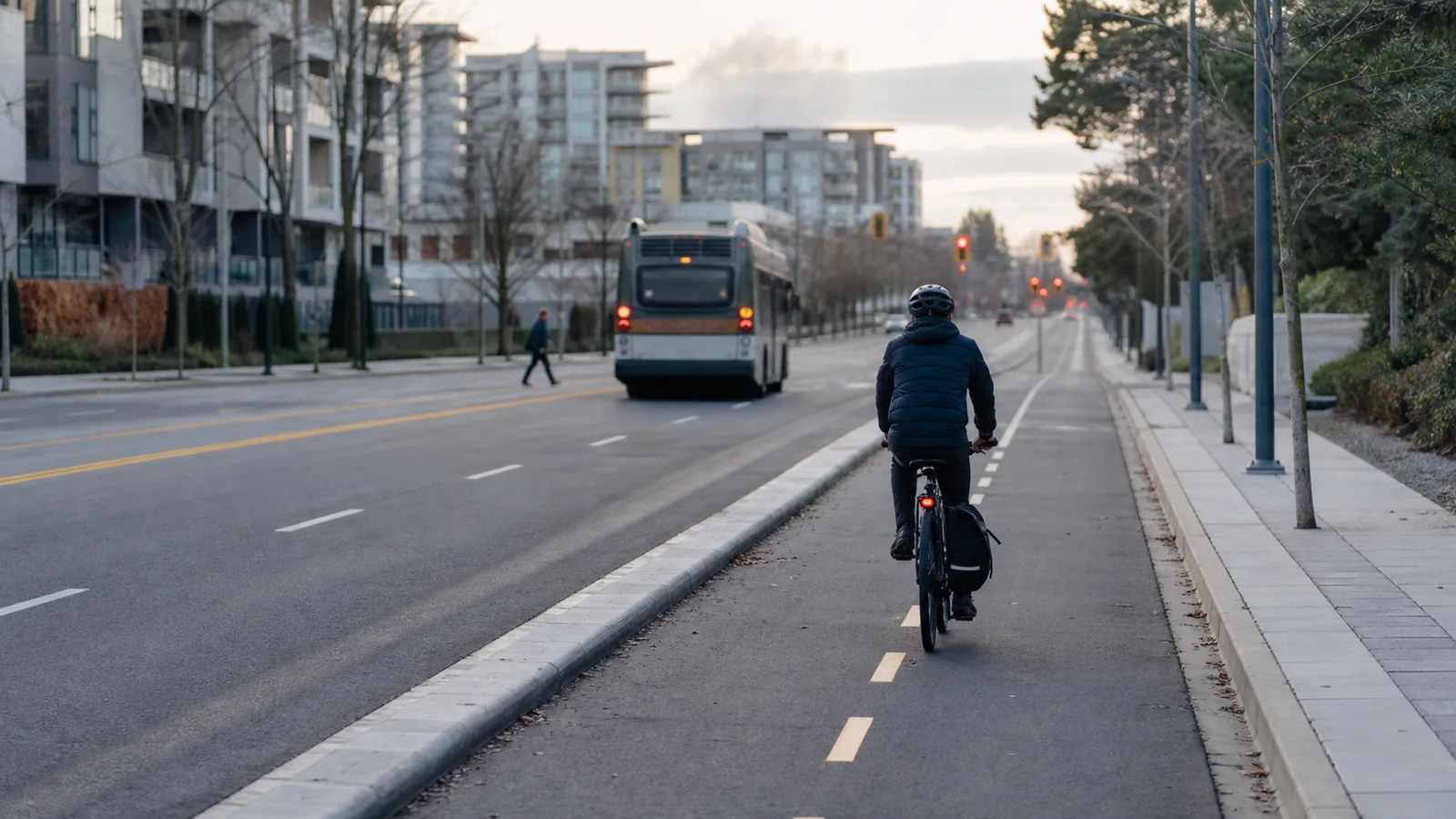
What each of the four vulnerable groups needs from you, what the collision looks like in each case, and which habit stops it. Not a list of good intentions.
Every provincial knowledge test carries a block of questions about sharing the road, and most people treat it as the easy part. Be careful around cyclists, watch for pedestrians, give trucks room. Nobody disagrees with any of that, and none of it changes what a driver does at the moment it matters.
The useful version is specific. Each of these road users is hurt by a different mistake, made in a different place, usually by a driver who was looking somewhere reasonable at the time. A cyclist gets hit by a right turn. A pedestrian gets hit stepping out from behind something. A motorcycle gets hit by a left turn across it. A truck hurts you rather than the other way around, and it does it because you were in the space it needs.
This guide takes them one at a time.
The rule underneath all four
A collision between two cars is an argument about damage. A collision between a car and anybody outside a car is an argument about injury, and the person outside the car loses it whoever was in the right. That imbalance is the whole reason these rules exist, and the reason they are written as duties on the driver rather than as duties shared out evenly.
It also explains a pattern in the test questions. Where a question puts your right of way against the safety of somebody on foot or on a bike, the answer is almost never the one where you take your turn. The rules hand you priority over other vehicles. They do not hand you priority over a person.
The warning signs below are the road telling you where these people will be. A crossing sign, a school sign or a playground sign is not decoration. It marks a place where somebody will step onto the road with nothing to protect them and no signal holding traffic for them.
- Pedestrian crossing ahead
- School crossing
- Playground zone
Cyclists, and the turn that catches them
The collision to know is the right hook. You pass a cyclist, you reach the corner, you turn right across the line they were travelling on, and they arrive in that space at the same moment you do. From inside the car it feels as though they appeared. They did not. They were beside you, in the wedge your mirrors never cover.
The habit that prevents it is a shoulder check to the right before every right turn, made after you signal and before you begin to turn the wheel. A mirror is not enough, because the mirror is exactly what misses them. If a rider is there, wait behind them and turn once they have cleared the corner rather than trying to beat them to it.
The other one is the door. A parked car with somebody sitting in it is a door about to open into the bike lane, so a rider who takes the middle of the lane rather than hugging the parked cars is doing the right thing, not being difficult. Give a cyclist the room of a full lane change when you pass, and open your own door with your far hand so that your body turns and your eyes go back down the lane.
What the mirrors miss
- Your vehicle
- Another vehicle
People on foot, and the ones you cannot see yet
Pedestrians are rarely hit in the open. They are hit stepping out from behind something: a parked van, a bus at a stop, a snow bank, the front of a stopped school bus. The rule that protects them is not about watching harder, it is about slowing where the sight line is broken so the space you cannot see stays a space you could still stop in.
Children are a separate problem because they behave differently. They cross where they are rather than where the crossing is, they run when they see the person they came to meet, and they judge the speed of a car badly. That is why the school and playground signs use a colour used for nothing else, and why the reduced limit inside those zones drops further below the surrounding street than feels necessary.
The school bus is the sharpest case of all. Red lamps flashing and the stop arm out means traffic stops in both directions on a road with no median, because a child is about to cross in front of the bus where the driver behind it cannot see them. Where a raised median or a barrier divides the road, traffic on the far side keeps moving, because no child is crossing that. A painted line is not a median.
Stopping for a school bus
- Your vehicle
- Another vehicle
- Where it goes
- School zone
- School bus stop ahead
Motorcycles: small, quick, and easy to look straight through
The classic motorcycle collision is a car turning left across an oncoming rider. The driver looked, saw no car, and turned. A motorcycle presents a narrow shape that does not grow in the windscreen the way a car does, so it reads as further away and slower than it is, and a gap that would be fine for an oncoming car is not fine for a rider closing faster than you judged.
Two fixes. Look for a motorcycle specifically rather than for a gap, because a mind scanning for cars will not register one. And when you find one, assume it is nearer and quicker than it looks, then take the gap after the one you were going to take.
In traffic, give a motorcycle the following distance you would give a car and then some. A rider can stop hard, they can be unsettled by a pothole or a wet manhole cover you would not notice, and they have nothing between them and your bumper. They also use the width of the lane on purpose, moving left and right to stay visible and to keep out of the oil down the middle. A rider changing position in the lane is working, not wandering.
Counting your following distance
- Your vehicle
- Another vehicle
- Where it goes
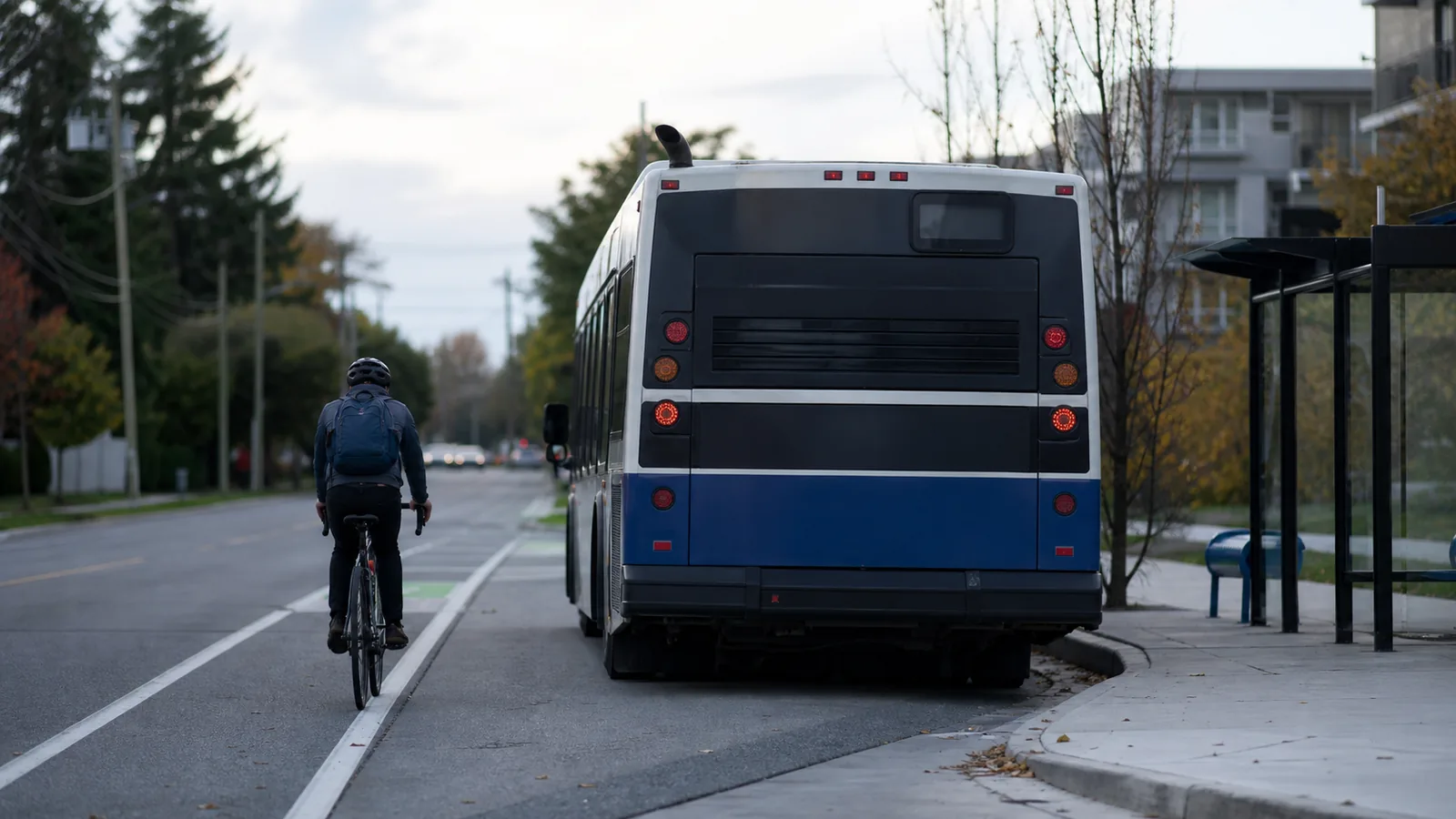
Trucks and buses: their limits become your problem
A loaded truck needs a great deal more distance to stop than you do, it cannot see the lane beside its own doors for a long stretch behind the cab, and it swings wide before a turn because the trailer cuts the corner the tractor took. None of that is fixable by the driver. It is what the vehicle does.
So the rules are about staying out of the places where those limits bite. Do not sit alongside a truck. Do not cut in front of one and then brake for your exit, because the space you just took was its stopping distance. Do not squeeze up the inside of a truck that has signalled a right turn, because that gap closes as the trailer follows the cab around.
Passing takes longer than it looks. You need a gap long enough to get past the whole length and back in without the truck having to lift off, and on a hill a heavy vehicle that was slow on the way up is not slow on the way down. Transit buses have a claim of their own in some provinces: where a bus at a stop signals to pull back into traffic, the driver in the lane beside it has to yield.
Which lane to be in
- Your vehicle
- Another vehicle
- Where it goes
The street where all of them are at once
A residential main street in the late afternoon has every one of these on it: a delivery van blocking the bike lane, a rider going around it into your lane, children on the pavement, a bus pulling out, a truck reversing into a yard. This is where the tidy separate rules have to be held all at once, and where speed does more work than anything else you control.
Lower speed buys the one thing that helps in every case, which is time. Time to see the rider come round the van, time to stop for the child who steps out, time to let the bus go rather than racing it. The difference between arriving at that street quickly and arriving at it calmly is a handful of seconds over the length of the trip, and everything at the point of contact.
The last habit is to stop reading other road users as obstacles between you and your turning. A cyclist holding the lane, a bus indicating, a truck taking two lanes to get round a corner: each of those is somebody doing the correct thing for the vehicle they are in. Seeing them that way is what makes the rest of this automatic.
- Passing prohibited
- Lane ends
- Merge
Worth remembering
- Shoulder check to the right before every right turn. The mirror is the thing that misses a cyclist.
- Give a rider the room of a full lane change, and open your door with your far hand.
- Pedestrians are hit stepping out from behind something. Slow down where the sight line is broken.
- Red lamps on a school bus stop both directions unless a raised median divides the road. Paint is not a median.
- Look for a motorcycle by name, then assume it is closer and faster than it looks.
- Never sit beside a truck, and never cut in front of one to brake.
Questions people ask
How much room should you give a cyclist when passing?
Treat it as a lane change rather than a squeeze past. Move fully into the next lane where you can, and wait until you can do that instead of passing inside the same lane. If the road is too narrow to move over, stay behind until it opens up.
Why do cyclists ride in the middle of the lane?
To stay visible, and to stay out of range of a car door opening in front of them. A rider holding the lane is following the safest line available, and passing them means moving into the next lane rather than sharing theirs.
Why are motorcycles hard to see?
A narrow shape does not grow in your windscreen the way a wide one does, so the mind reads it as further away and slower than it is. That misjudgement is why the left turn across an oncoming rider is the collision that happens most.
Where can a truck driver not see you?
Along both sides, worst on the right, and for a long stretch directly behind the trailer. The working rule is simpler than the diagram: do not sit beside a truck, and do not sit close behind one.
Do I have to stop for a school bus coming the other way?
Yes, on a road with no median or physical barrier. Where a raised median divides the two directions, only traffic travelling the same way as the bus has to stop. A painted centre line does not divide a road.
Now answer some questions on it
Read next
Road sign shapes and colours, and how to read a sign you have never seen
Shape, colour and symbol carry the meaning before you read a word. Learn the pattern once and you can work out an unfamiliar sign before you have driven past it.
Winter driving, and what actually changes
Snow, slush, freezing rain and black ice are four different problems. What changes about your speed, your gap and your hands, and what to do when the car lets go.