Free G1 practice test 2026: 137 questions with answers
For the real G1 test, 80% total score to pass. Our simulation uses 20 sign questions and 20 rules questions, with 16 correct in each practice section. This free practice hub has 137 questions with the answer, an explanation and a citation. Source: DriveTest, Knowledge Tests, checked 2026-09-15.
137 questions69 on road signs68 on the rulesPractice mark 16 of 20 in road signs and 16 of 20 in rules of the road
The number beside each subject is how many questions we have written on it for Ontario. A subject appears here once there are enough of them to be worth sitting down with.
A sample of 10 questions from the G1 test bank, spread across its subjects and shown in full before you start.
Sample question 1Road signs
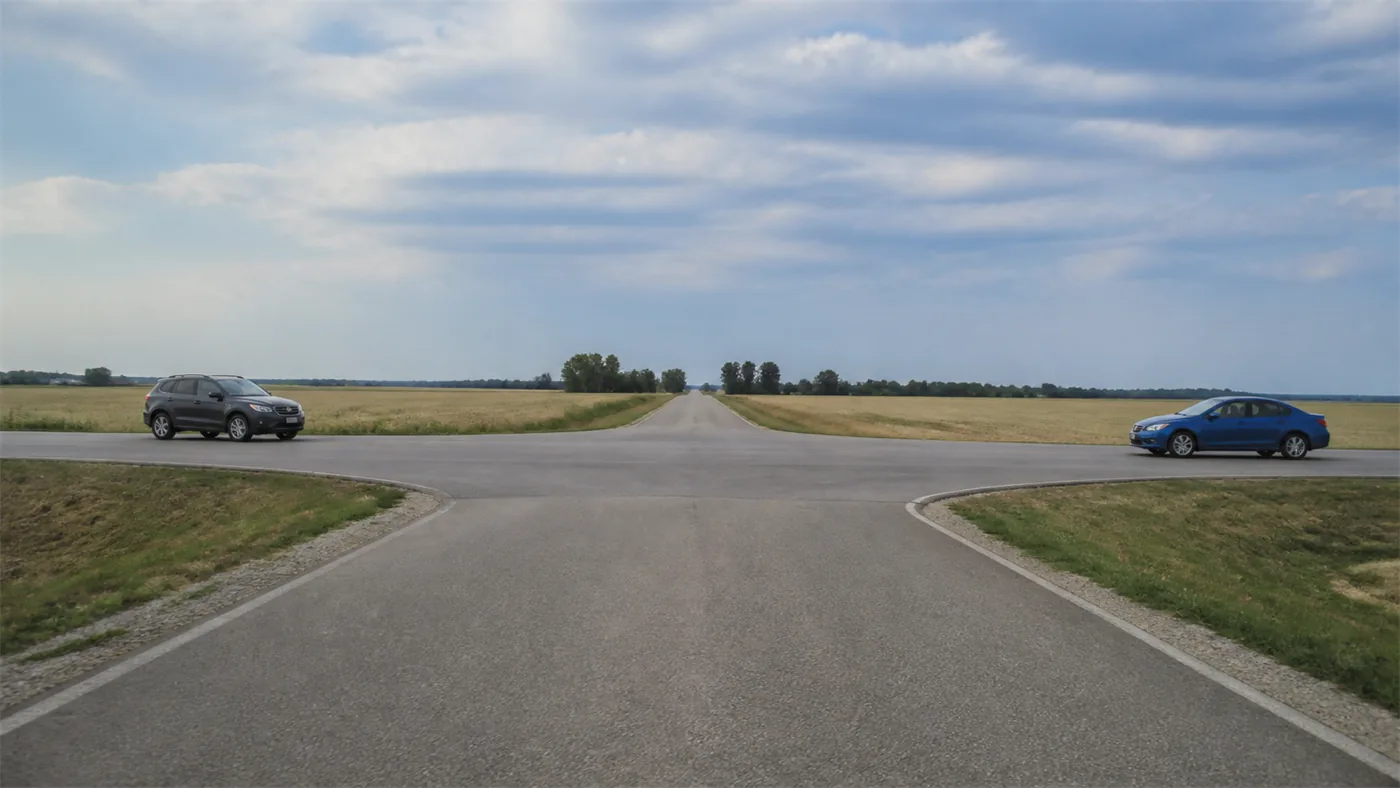
You reach this sign at a quiet intersection. You can see a long way in both directions and there is no other vehicle or person in sight. What does the sign require?
Correct answer: Come to a complete stop, even though the road looks empty
The duty to stop does not depend on whether anyone else is there. A complete stop means the wheels stop turning, and the rule is absolute because a rolling approach hides the cyclist or the child that a stopped driver has time to see.
Highway Traffic Act (Ontario)section 136
Sample question 2Rules of the road
You reach a four way stop at the same moment as a driver on the cross street to your right. Both of you have stopped, and neither of you is signalling a turn.
Correct answer: The driver on your right goes first
At a four way stop the first driver to stop goes first. When two drivers stop together, the one on the right has the right of way. The rule exists so that two people facing the same doubt settle it the same way instead of guessing at each other.
Highway Traffic Act (Ontario)
Sample question 3Rules of the road
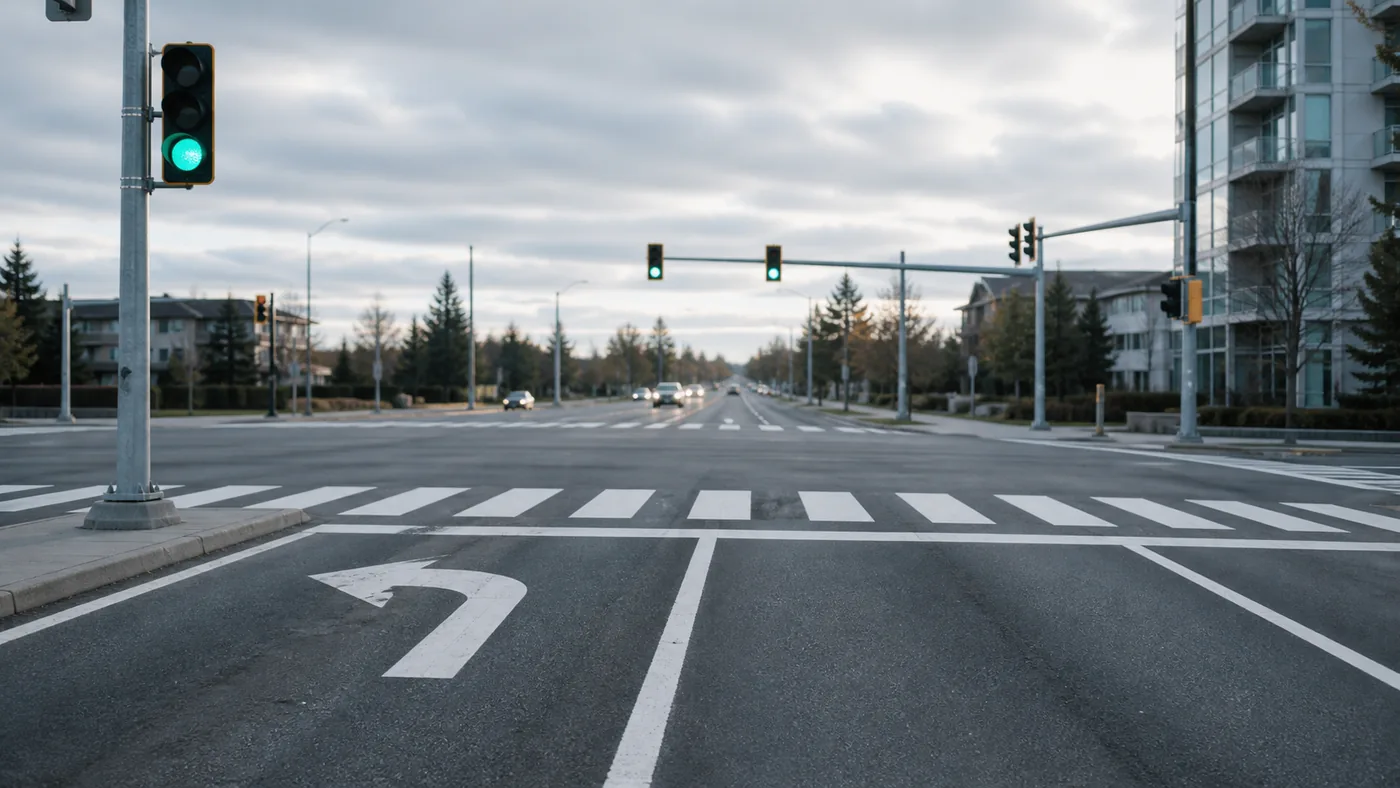
The light ahead turns amber as you approach. You are close enough that stopping would mean braking hard, and a car is following you closely.
Correct answer: Carry on through the intersection with care, since you cannot stop safely
Amber means stop if you can do it safely. When you are so close that stopping would be violent or would put the driver behind into your rear bumper, going through is the safer choice. The real lesson comes earlier: read the light from further back and cover the brake, so you are rarely caught in that zone at all.
Highway Traffic Act (Ontario)
Sample question 4Rules of the road
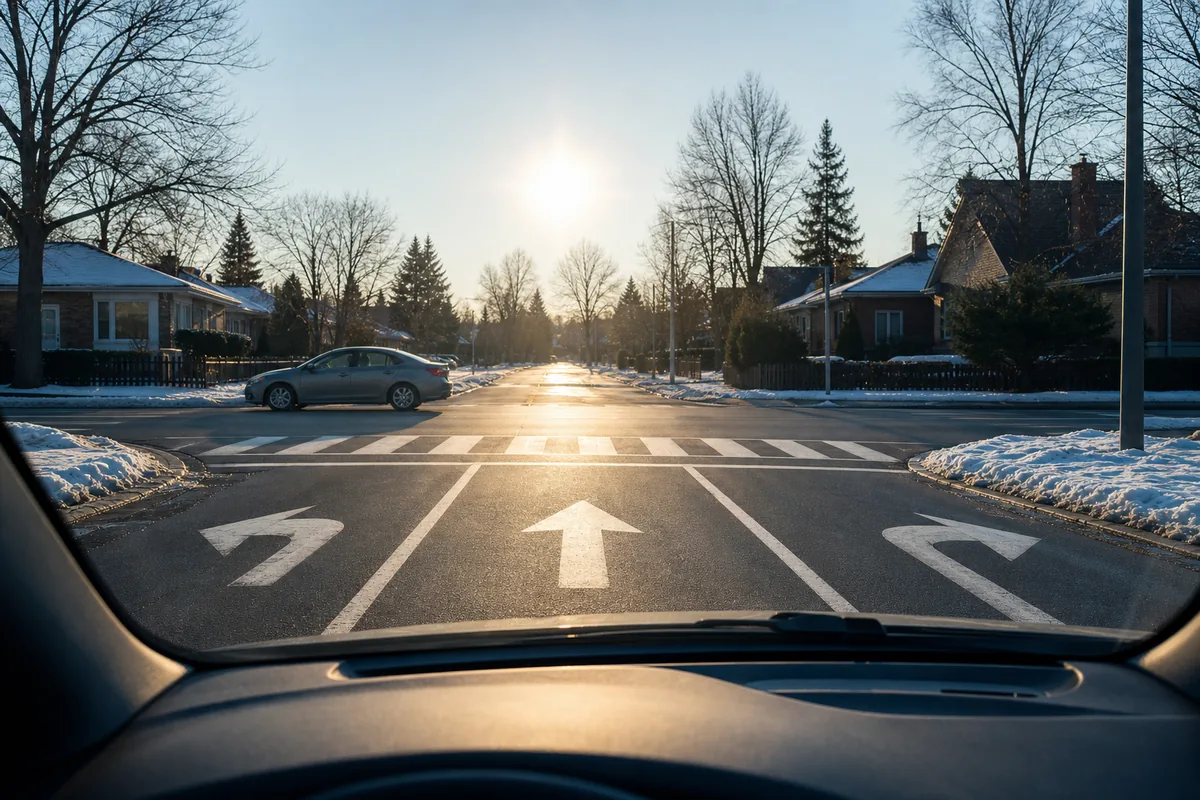
You turn from a main road onto a residential street inside a town, and there is no speed limit sign anywhere in sight.
Correct answer: The limit is 50 km/h unless a sign says otherwise
Ontario sets a default of 50 km/h inside cities, towns, villages and other built up areas, and 80 km/h on roads outside them, and those figures apply with no sign present. A municipality can post something lower, and many residential streets are posted lower, but it takes a sign to change it. When you see no sign at all, the built up area default is what you are held to.
Highway Traffic Act (Ontario)
Sample question 5Rules of the road
You come up behind a slower vehicle on a two lane road. The line down the centre is broken on your side and solid on the other side.
Correct answer: You may pass if the road ahead is clear, because the broken line is on your side
The line on your side of the centre is the one that speaks to you: broken means passing is permitted, solid means it is not. The other half is a message to oncoming drivers, telling them they may not come into your space. Permission is not the whole test, though, because you still need enough clear road to get out, past and back in.
Highway Traffic Act (Ontario)
Sample question 6Rules of the road
You are parking facing uphill on a street with a curb on your right.
Correct answer: Turn the front wheels to the left, away from the curb
Facing uphill the car rolls backwards if it gets away from you, so you want the wheels pointing away from the curb: rolling back swings the car into the curb and the tire stops it. Facing downhill you want the opposite, wheels turned towards the curb. Set the parking brake and leave the car in park or in gear either way, because the curb is the backup and not the plan.
Highway Traffic Act (Ontario)
Sample question 7Rules of the road
On a two lane road with no median, a school bus stopped ahead of you on the far side has its upper red lights flashing and its stop arm out. You are travelling towards it.
Correct answer: Stop, and stay stopped until the red lights stop flashing and the arm folds in
On a road with no median or barrier, traffic in both directions stops for a school bus showing flashing red lights. Children cross in front of the bus to reach the far side, which is exactly where an oncoming driver would be. Wait for the lights to go off and the arm to fold back, not for the moment the coast looks clear to you.
Highway Traffic Act (Ontario)
Sample question 8Rules of the road
You hold a G1 and you have had a single drink at a family dinner. You feel completely normal and the drive home is short.
Correct answer: You must not drive, because a novice driver has to have no alcohol at all
Novice drivers, and every driver aged 21 and under, must have no alcohol in their body while driving. The limit that applies to fully licensed adult drivers is not the limit that applies to you, and being caught above zero brings an immediate roadside suspension. Feeling fine is not a measurement, it is a guess.
Highway Traffic Act (Ontario)
Sample question 9Rules of the road
You hold a G1. Your cousin, who has held a full G licence for two years, offers to sit beside you while you practise.
Correct answer: That does not work, because your accompanying driver needs at least four years of driving experience
A G1 driver must be accompanied by someone who holds a full G licence and has at least four years of driving experience, sitting in the front passenger seat, with their own blood alcohol below the legal limit. The four year rule is there so the person beside you has seen enough situations to talk you through one. Driving with the wrong supervisor counts the same as driving alone.
Highway Traffic Act (Ontario)
Sample question 10Rules of the road
The back of your car starts to slide out to the right as you go around a slippery bend.
Correct answer: Ease off the accelerator, and look and steer where you want the car to go
Braking hard or steering sharply in a skid uses up what little grip the tires have left. Lifting off gently lets them start rolling again, and looking and steering towards the space you want carries the car back into line. Small, smooth inputs recover a skid, and big ones extend it.
Highway Traffic Act (Ontario)
Other licence classes in Ontario
A few questions from each class bank. Open its page to choose a full test, a practice run, signs or one subject.
Motorcycle: M1 test
Sample question 1Road signs
This sign faces you on a damp afternoon, just before a stretch of resurfaced road. What does it ask of a rider?
Correct answer: Slow down before you reach it, then keep the bike upright and your inputs gentle
A motorcycle loses grip at one of two small contact patches and has nothing to catch it when that happens. Slowing before the low grip section, then holding a steady throttle with the bike as upright as the road allows, keeps the demand on both tires low while the surface has little to give.
Highway Traffic Act (Ontario)
Sample question 2Rules of the road
You are riding straight through on a green light. An oncoming driver is waiting to turn left across your path and is looking directly at you.
Correct answer: Slow, cover the brakes and keep a way out, because the driver may still turn across you
A motorcycle is a narrow shape with no width to judge, so drivers read it as further away and slower than it really is. A driver can look straight at you and still decide the gap belongs to them, which is why the answer is speed in hand and an escape path rather than trust in the look.
Highway Traffic Act (Ontario)
Sample question 3Rules of the road
You are riding at road speed on an open road and need to change direction to the right for a bend. What actually turns the motorcycle?
Correct answer: A light forward press on the right handgrip, which leans the bike to the right
Above walking pace a motorcycle turns by leaning, and the fastest way to make it lean is to steer the front wheel very slightly the other way for an instant. Press the right grip and the bike falls into a right lean. Riders who never learn this find they cannot make the machine go where they want when a corner tightens.
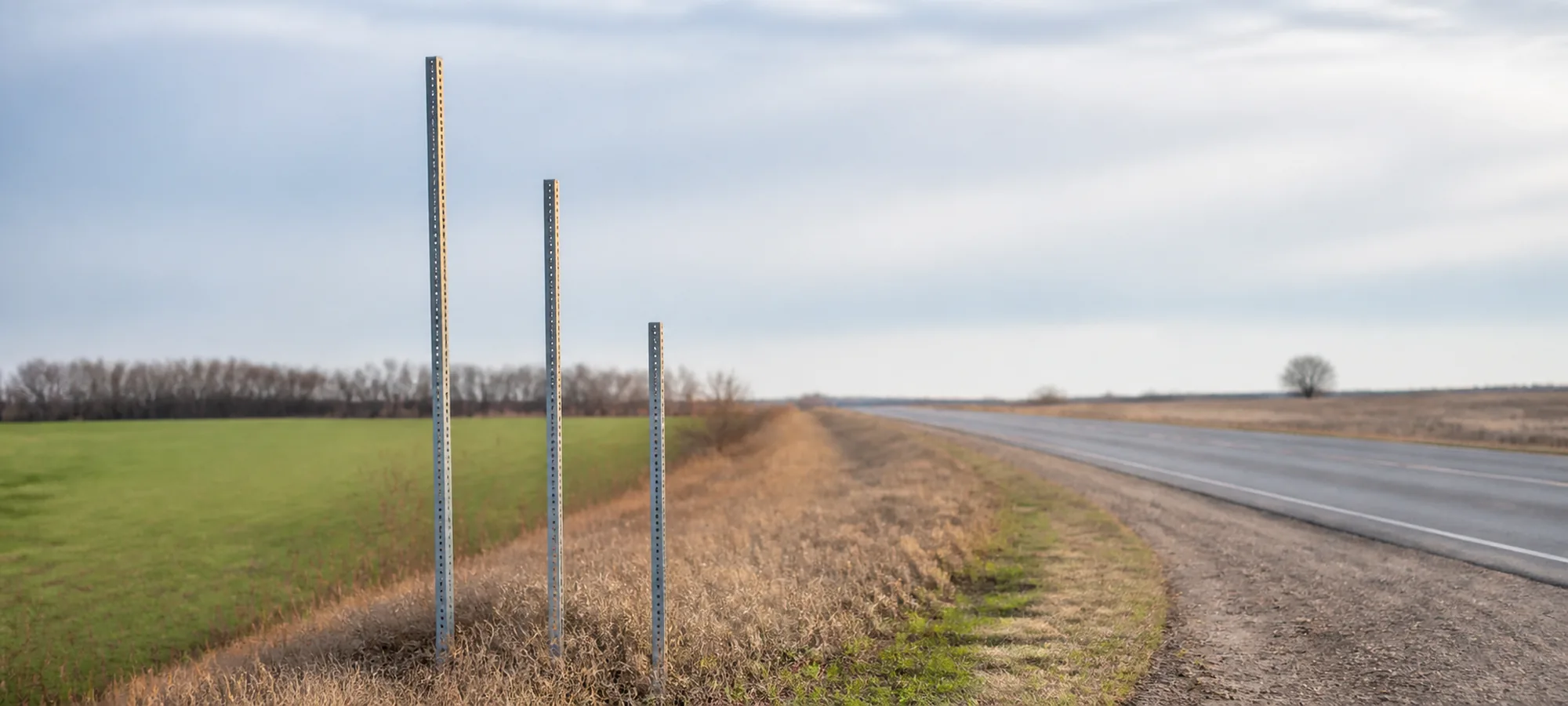
You are loaded close to the weight your vehicle is rated for, and this sign appears at the top of a long descent.
Correct answer: Choose your low gear before the descent begins and let the engine hold the speed
Gravity works on weight, so a loaded vehicle gathers speed on a grade far faster than an empty one. Once it is rolling quickly a transmission may refuse the lower gear, leaving you nothing but service brakes that lose their bite as they heat. Pick the gear at the top, where you still have a choice.
Highway Traffic Act (Ontario)
Sample question 2Rules of the road
You are waiting to turn left out of a yard onto a busy road. A driver stops and flashes their lights to wave you across.
Correct answer: Go only once you have seen for yourself that the lanes you must cross are clear, because a long vehicle takes time to cross and the other lanes have agreed to nothing
A driver who waves you out can only speak for their own vehicle. They cannot see what is coming up the lane beside them or on the far side of the road, and a long vehicle spends a long time lying across both. Acknowledge the courtesy, then make your own decision on what you can actually see.
Highway Traffic Act (Ontario)
Sample question 3Rules of the road
You are turning right at a city corner in a tractor trailer. As the turn develops, where do the trailer wheels go compared with the cab?
Correct answer: They cut inside the path the cab takes, closer to the curb and anything standing on it
In any turn the rear wheels follow a tighter arc than the front ones, and the longer the vehicle the bigger that difference becomes. It is why a trailer can climb a curb the cab cleared easily. Watch the trailer in the mirror all the way through the turn, not only at the start.
Taxi and passenger transport: Class F knowledge test
Sample question 1Road signs
Your passenger points at the entrance beside this sign and says to pull in there, since they will be out of the vehicle in seconds.
Correct answer: Do not stop here at all, and carry on to a place where stopping is allowed
This sign forbids stopping of any kind, so a quick drop off is exactly the thing it rules out. Stretches marked this way are usually where a stopped vehicle would hide the road from someone or block a lane that has to keep moving. Tell the passenger where you can stop instead, then take them there.
Highway Traffic Act (Ontario)
Sample question 2Rules of the road
Your passenger has gone and you are ready to pull out from the curb into moving traffic.
Correct answer: Signal, check the mirror and your blind spot, and wait for a gap you are not forcing anyone to make
A vehicle already on the road has the right of way over one joining from the curb, so the gap has to exist before you move rather than because you moved. A signal says what you want, not what anybody owes you. The shoulder check matters most here, because a cyclist coming up your right side sits exactly where the mirror is weakest.
Highway Traffic Act (Ontario)
Sample question 3Rules of the road
You are in the centre lane on the approach to an intersection when your passenger says, suddenly, that the turn is here on the right.
Correct answer: Carry on, then turn where you can do it safely and come back around
A sudden move across a lane is the swerve every other driver then has to react to, and what is beside you may be a cyclist you cannot pick out from the centre lane. Where the passenger is going is their decision, and how the vehicle gets there is yours. Saying calmly that you will come back around settles it faster than an argument held mid turn.
Every question here was written against the handbook and the legislation that Ontario Ministry of Transportation publishes, and every one carries the reason for its answer and the section it rests on.
Questions written
137
On road signs
69
On the rules
68
Subjects covered
12
All four figures are counted from the questions themselves when the site is built, rather than typed in by hand.
None of them is copied from another practice site, and none is generated from an unnamed source. If a question looks wrong to you, it may be wrong: say which one and what you think it should say, through the corrections route on the methodology page, and it gets checked against the source rather than argued about.
We use Google Analytics and Microsoft Clarity to see which pages help learners, and advertising cookies to keep the site free to use. Accept to allow them, or decline. How your data is handled