ICBC knowledge test practice 2026: 126 free questions
For the real ICBC knowledge test, 50 questions, pass 40 of 50, 45 minutes. This free practice hub has 126 questions with the answer, an explanation and a citation. Source: ICBC published graduated licensing and knowledge test information, checked 2026-08-27.
126 questions64 on road signs62 on the rulesPass mark 40 of 50 correct
The number beside each subject is how many questions we have written on it for British Columbia. A subject appears here once there are enough of them to be worth sitting down with.
A sample of 10 questions from the ICBC knowledge test bank, spread across its subjects and shown in full before you start.
Sample question 1Road signs
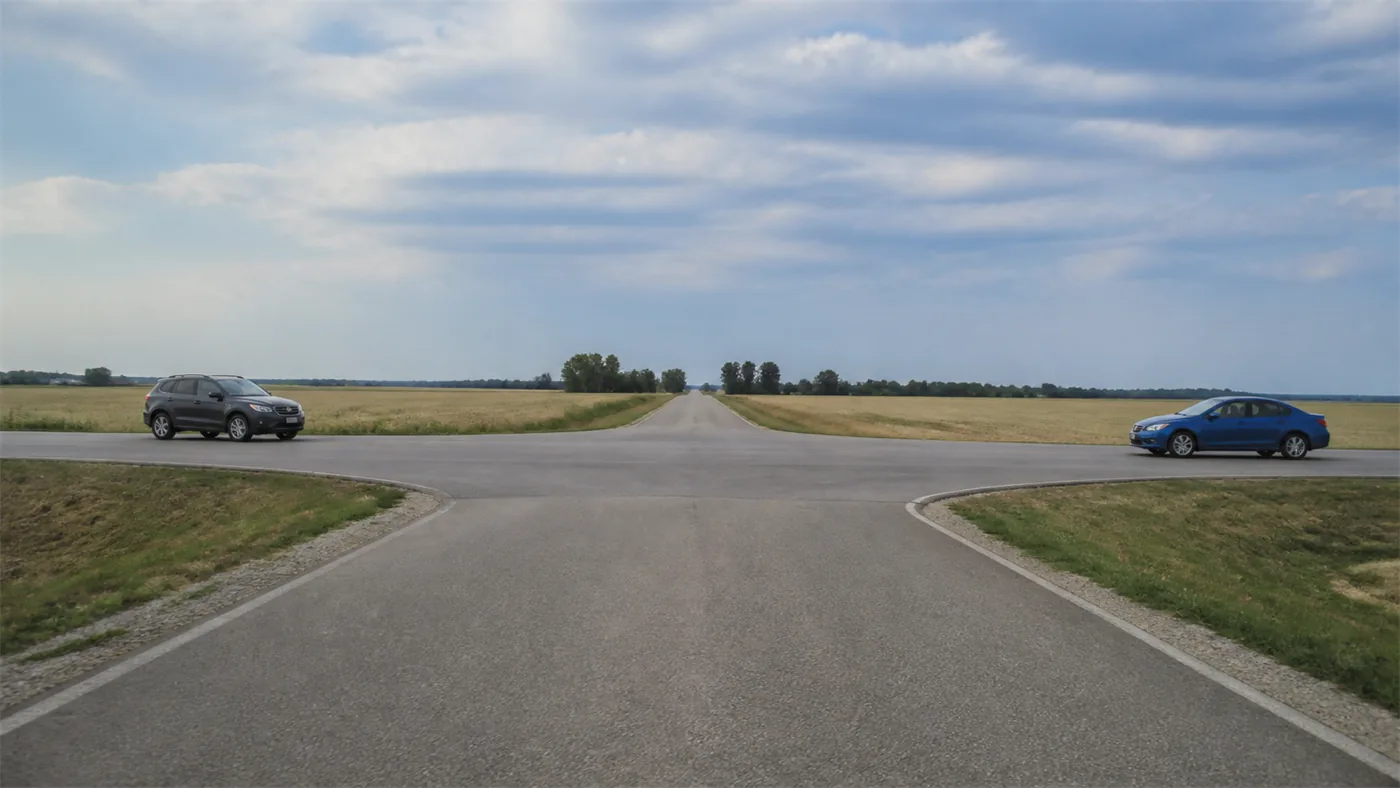
You reach this sign at a quiet intersection with no painted stop line and no crosswalk. Where must the vehicle actually come to rest?
Correct answer: Just before the point where the crossing road begins
The stop belongs at the last point where you can see along the cross street without putting your bumper in its path, so with no line and no crosswalk that point is the edge of the crossing roadway. Stopping too far back hides the cross street from you, and creeping past it hands the decision to the driver who has the right of way.
Motor Vehicle Act (British Columbia)
Sample question 2Rules of the road
You reach a four way stop at the same moment as a driver coming the other way. You are signalling a left turn and they are going straight through. Who moves first?
Correct answer: The driver going straight, and you turn once they have cleared
When two drivers arrive together and face each other, the one turning left gives way to the one going straight. A left turn crosses the path of the oncoming driver, so the turning driver is the one who waits for a clear gap. Signalling early tells them what you plan to do, but it does not buy you the right to go first.
Motor Vehicle Act (British Columbia)
Sample question 3Rules of the road
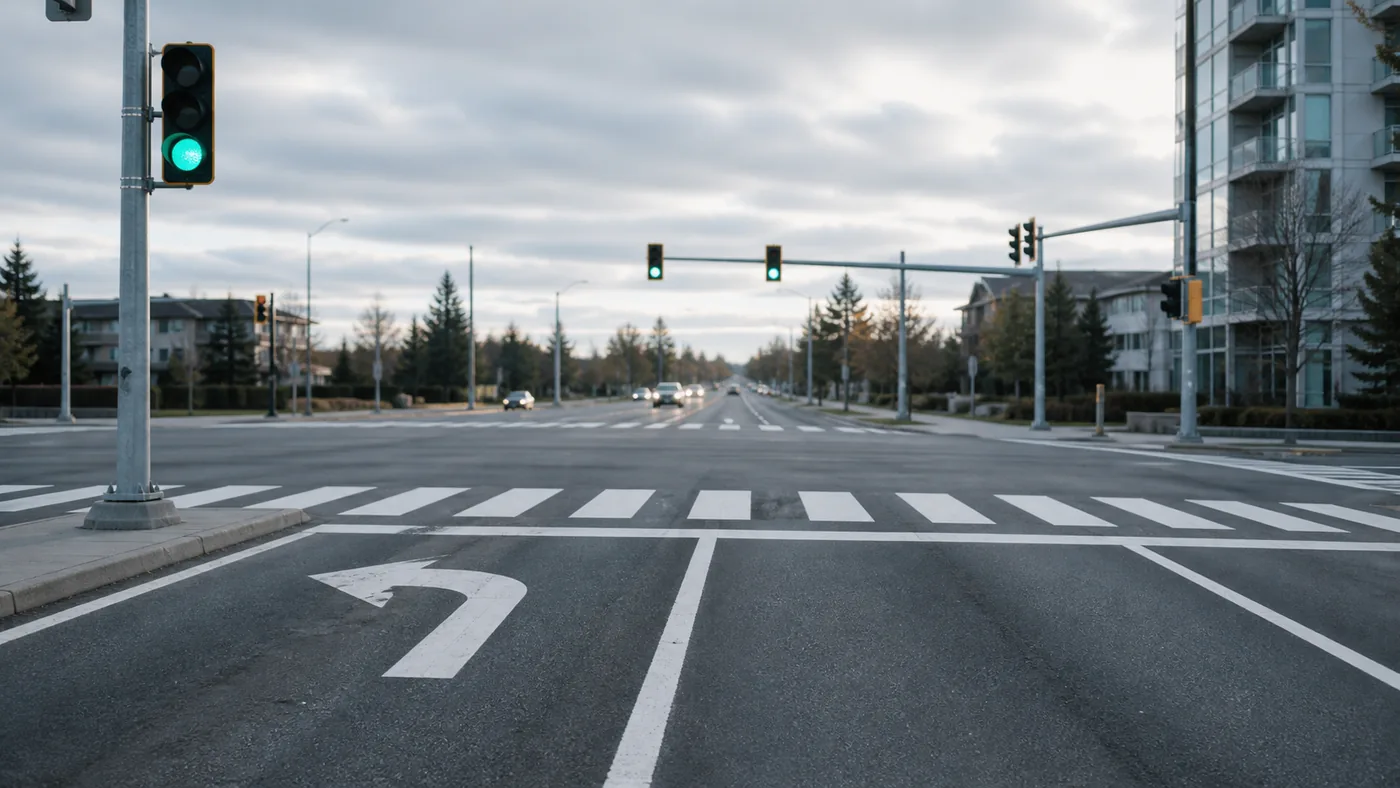
You are stopped inside the intersection waiting for a gap to turn left. The light turns amber and the oncoming traffic starts to stop.
Correct answer: Complete the turn as soon as the oncoming lanes are clear
Once you are legally inside the intersection you are meant to clear it, not sit through another cycle. Wait until the oncoming vehicles have actually stopped, then finish the turn. Keep your wheels pointed straight while you wait, so a hit from behind cannot push you into oncoming traffic.
Motor Vehicle Act (British Columbia)
Sample question 4Rules of the road
You are following a car on a dry road in daylight. It passes a signpost and you reach the same post about one and a half seconds later.
Correct answer: You are too close, because two seconds is the least you should leave in good conditions
Counting the gap in seconds works at any speed, because the space it buys grows as you go faster. Two seconds is the smallest sensible gap on a dry road with a clear view, and most of it is used up simply reacting before the brakes do anything. Less than that and you are relying on the driver ahead never braking hard.
Motor Vehicle Act (British Columbia)
Sample question 5Rules of the road
You signal to change lanes on a multi lane road, your mirrors look clear, and as you begin to move across a horn sounds beside you.
Correct answer: A mirror check on its own is not enough, and a shoulder check covers the area mirrors miss
Every car has an area behind and beside it that the mirrors do not cover, and a whole vehicle fits inside it. A quick turn of the head before you move is the only way to check that space. A signal asks for the lane, it does not take it.
Motor Vehicle Act (British Columbia)
Sample question 6Rules of the road
You park facing downhill on a street with a curb. Which way do you leave the front wheels?
Correct answer: Turned toward the curb, so the vehicle would roll into it if it moved
Turning the wheels toward the curb gives the car something solid to stop against if the brake or the transmission lets go. Facing downhill, gravity pulls the front of the car forward, so the front tires need to be pointing at the curb. The parking brake still goes on, because the wheels are the backup and not the plan.
Motor Vehicle Act (British Columbia)
Sample question 7Rules of the road
A school bus stopped on the other side of an undivided two lane road has its red lights flashing as you approach.
Correct answer: Stop before you reach it and stay stopped until the lights stop flashing and the bus moves off
Flashing red lights mean children are getting on or off, and they often cross in front of the bus where nobody can see them. On an undivided road, traffic in both directions stops and waits. Stop well back so you can see the whole area around the bus before you move again.
Motor Vehicle Act (British Columbia)
Sample question 8Rules of the road
You hold a novice licence. You have one drink at a party, wait an hour, and feel completely normal before driving home.
Correct answer: Any alcohol at all can end in a roadside prohibition, because the limit for a new driver is zero
Drivers in the learner and novice stages have to be at zero, which is a stricter standard than the one applied to a full licence holder. It is set that way because crash risk for new drivers climbs at levels that barely register for anyone else. Feeling normal is not evidence, and the roadside device does not measure how you feel.
Motor Vehicle Act (British Columbia)
Sample question 9Rules of the road
You are in the learner stage in British Columbia, driving with your supervisor beside you, and the L sign is in the glovebox because you find it embarrassing.
Correct answer: Not fine, the L sign has to be displayed on the outside of the back of the vehicle whenever you drive
Displaying the sign is a condition attached to the licence, and driving without it is one of the easiest violations to collect in this stage. The sign tells the drivers around you to expect a learner and to leave more room. Keep a spare sign in the car if you drive more than one vehicle.
Motor Vehicle Act (British Columbia)
Sample question 10Rules of the road
The back of your car steps out to the right as you go through a bend on a wet road.
Correct answer: Ease off the accelerator, look where you want the car to go, and steer that way
A skid ends when the tires start rolling in the direction the car is travelling again, so the first move is to remove whatever caused it, usually throttle or hard braking. Your hands follow your eyes, which is why you look at the way out of the corner and not at the obstacle. Keep the corrections small and smooth, and unwind the steering as grip returns.
Motor Vehicle Act (British Columbia)
Other licence classes in British Columbia
A few questions from each class bank. Open its page to choose a full test, a practice run, signs or one subject.
Motorcycle: Motorcycle knowledge test
Sample question 1Road signs
Rain has started and you meet this sign on a busy two lane road. The car ahead of you holds its speed and stays in the middle of the lane.
Correct answer: Slow more than the car does and move out of the middle of the lane
A motorcycle puts two small patches of rubber on the road where a car puts four large ones, so the same wet surface costs you far more of your margin. The middle of a traffic lane is also where oil and rubber build up, and rain lifts that film to the surface. Slowing further and riding in a wheel track gives you cleaner pavement and more room to be wrong.
Motor Vehicle Act (British Columbia)
Sample question 2Rules of the road
You are waiting at an intersection to turn left. An oncoming car is signalling a right turn into the street you want to leave by.
Correct answer: Wait until the car has actually begun its turn and slowed for it
A signal is a statement of intent, not a promise, and one left on from an earlier turn or switched on by mistake will put a rider under the front of a car that never slowed. Waiting for the car to slow and start turning is the only evidence worth acting on. On a motorcycle the cost of being wrong is not a dented panel, so buy the extra second.
Motor Vehicle Act (British Columbia)
Sample question 3Rules of the road
At highway speed you need to move the bike to the left quickly to avoid something in your path.
Correct answer: Press forward on the left handgrip, which leans the bike to the left
Above walking pace a motorcycle turns by leaning, and the fastest way to make it lean is to steer the front wheel very briefly the other way. Pressing the left grip does exactly that, so the bike drops to the left and turns left. This is why a rider who only shifts body weight moves so much more slowly than one who uses the bars, and why the reflex to pull the bar toward the danger steers you into it.
You are loaded close to your legal weight and this sign appears at the top of a long mountain descent. What should already have been done before the road starts to fall away?
Correct answer: Chosen the gear you intend to descend in and let the engine hold the speed
Gear selection is a decision made at the top, because a loaded vehicle that is already running too fast may not go back into a lower gear at all. Letting the engine hold the speed keeps the service brakes cool and in reserve for the moment you actually need them. Braking hard once the load is running is how drivers arrive at the bottom with nothing left.
Motor Vehicle Act (British Columbia)
Sample question 2Rules of the road
An emergency vehicle comes up behind you with lights and siren while you are loaded on a two lane road with a soft gravel shoulder.
Correct answer: Signal, slow down, and move over where the shoulder will carry your weight, stopping if you must
Yielding to an emergency vehicle means getting out of its way safely, and a loaded unit dropped onto a soft shoulder can sink, slide or roll onto its side. Slowing early and picking firm ground a little further on serves the emergency vehicle far better than a fast move that ends with the road blocked. Signal what you are doing so the driver behind you can read the plan.
Motor Vehicle Act (British Columbia)
Sample question 3Rules of the road
As a long vehicle turns a corner, what path do the rear wheels take compared with the front ones?
Correct answer: A tighter path, cutting inside the front wheels
The rear wheels always cut the corner compared with the front ones, and the longer the vehicle the more they cut. That is why a cab that looks well clear of a curb, a post or a waiting car can still put the trailer into it. Turning a long vehicle means steering the front of it wide enough that the back of it stays on the road.
Taxi and passenger transport: Class 4 knowledge test
Sample question 1Road signs
A passenger who is late leans forward at this sign and tells you the cross street is clear.
Correct answer: Stop completely and satisfy yourself the way is clear before moving
The stop is a full stop every time, and the person who answers for the vehicle is the driver. A passenger sees one slice of the road from one seat and carries none of the liability. Taking their word for a gap hands your judgment to someone who is not looking where you have to look.
Motor Vehicle Act (British Columbia)
Sample question 2Rules of the road
Your passenger is in and belted, and you are ready to pull away from the curb into moving traffic.
Correct answer: Signal, check the mirror and the blind spot, then wait for a gap you do not have to force
A vehicle leaving the curb gives way to traffic already in the lane, and a signal asks for a gap rather than creating one. The shoulder check matters most here, because a cyclist or a motorcycle can sit exactly where the mirror does not show them. Pulling away gently also keeps the people in the back settled in their seats.
Motor Vehicle Act (British Columbia)
Sample question 3Rules of the road
You are turning right into the side street where the address is, and a marked bike lane runs along your right side.
Correct answer: Signal, look into the bike lane and over your shoulder, and let any rider going straight go first
The rider carrying straight on is staying on their own path, so cutting across it is your move to make safely. Riders sit in the space a mirror alone can miss, which is why the shoulder check comes before the wheel turns. A turn taken a second later is still a turn.
Every question here was written against the handbook and the legislation that Insurance Corporation of British Columbia (ICBC) publishes, and every one carries the reason for its answer and the section it rests on.
Questions written
126
On road signs
64
On the rules
62
Subjects covered
12
All four figures are counted from the questions themselves when the site is built, rather than typed in by hand.
None of them is copied from another practice site, and none is generated from an unnamed source. If a question looks wrong to you, it may be wrong: say which one and what you think it should say, through the corrections route on the methodology page, and it gets checked against the source rather than argued about.
The length, the pass mark and the fee for the ICBC knowledge test are read off this record on the date beside it.
ICBC published graduated licensing and knowledge test information
Verified 2026-08-27
We use Google Analytics and Microsoft Clarity to see which pages help learners, and advertising cookies to keep the site free to use. Accept to allow them, or decline. How your data is handled