Class 1 knowledge test practice 2026: 60 free questions
For the real Class 1 knowledge test, 60 questions, pass 48 of 60, 75 minutes. This free practice hub has 60 questions with the answer, an explanation and a citation. Source: ICBC, Before you take your knowledge test (form MV2654), checked 2026-08-28.
60 questions20 on road signs40 on the rulesPass mark 48 of 60 correct
The number beside each subject is how many questions we have written on it for British Columbia truck. A subject appears here once there are enough of them to be worth sitting down with.
A sample of 10 questions from the Class 1 knowledge test bank, spread across its subjects and shown in full before you start.
Sample question 1Road signs
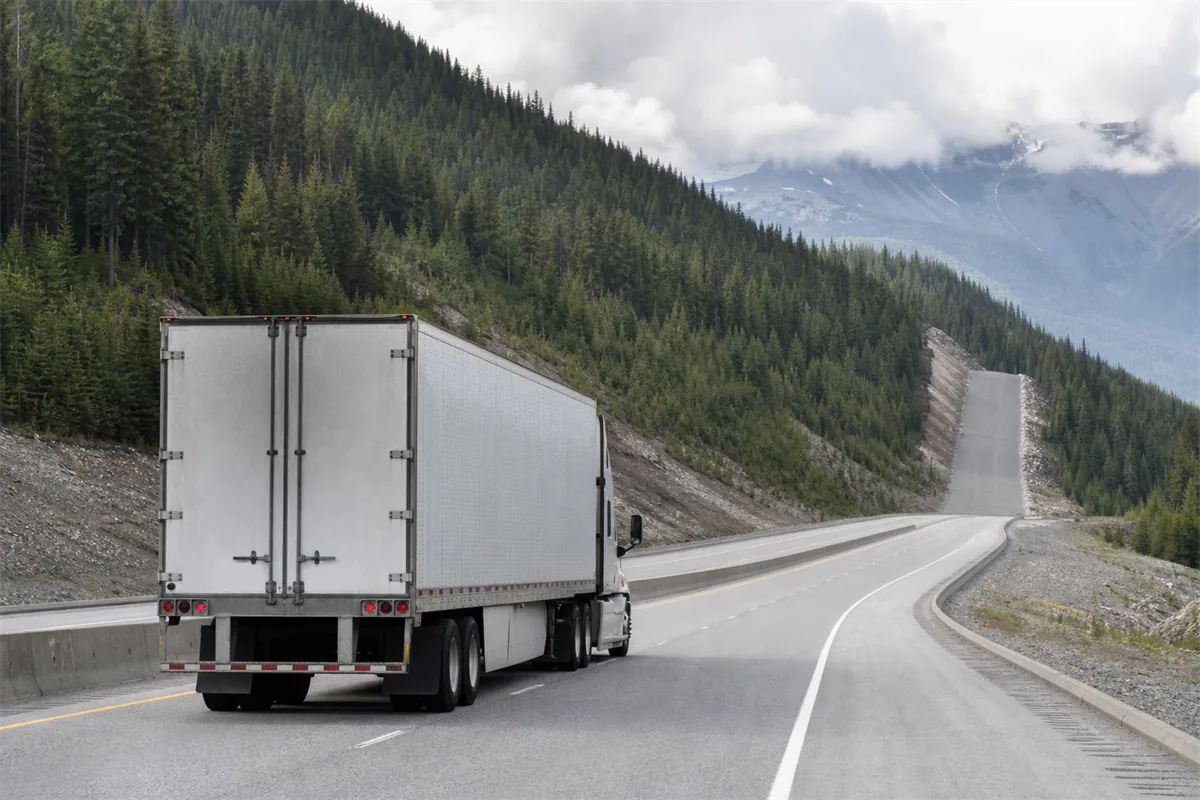
You are loaded close to your legal weight and this sign appears at the top of a long mountain descent. What should already have been done before the road starts to fall away?
Correct answer: Chosen the gear you intend to descend in and let the engine hold the speed
Gear selection is a decision made at the top, because a loaded vehicle that is already running too fast may not go back into a lower gear at all. Letting the engine hold the speed keeps the service brakes cool and in reserve for the moment you actually need them. Braking hard once the load is running is how drivers arrive at the bottom with nothing left.
Motor Vehicle Act (British Columbia)
Sample question 2Rules of the road
An emergency vehicle comes up behind you with lights and siren while you are loaded on a two lane road with a soft gravel shoulder.
Correct answer: Signal, slow down, and move over where the shoulder will carry your weight, stopping if you must
Yielding to an emergency vehicle means getting out of its way safely, and a loaded unit dropped onto a soft shoulder can sink, slide or roll onto its side. Slowing early and picking firm ground a little further on serves the emergency vehicle far better than a fast move that ends with the road blocked. Signal what you are doing so the driver behind you can read the plan.
Motor Vehicle Act (British Columbia)
Sample question 3Rules of the road
As a long vehicle turns a corner, what path do the rear wheels take compared with the front ones?
Correct answer: A tighter path, cutting inside the front wheels
The rear wheels always cut the corner compared with the front ones, and the longer the vehicle the more they cut. That is why a cab that looks well clear of a curb, a post or a waiting car can still put the trailer into it. Turning a long vehicle means steering the front of it wide enough that the back of it stays on the road.
Motor Vehicle Act (British Columbia)
Sample question 4Rules of the road
Part way down a long grade a driver notices the pedal is going further than it did at the top and the vehicle is slowing less.
Correct answer: The brakes have overheated, so the same effort produces less slowing
Continuous braking turns the energy of a moving vehicle into heat in the drums, and hot components expand and grip less than cold ones. The trap is that the obvious answer feels like more braking, which makes the heat worse and the fade deeper. Speed has to be held by the engine and the gear so the brakes stay cool enough to work when you ask them.
Motor Vehicle Act (British Columbia)
Sample question 5Rules of the road
You are climbing a long grade heavily loaded and your speed has dropped well below the traffic behind you.
Correct answer: Keep right, use a climbing lane where one exists, and let the traffic by
A slow vehicle in the through lane builds a line of frustrated drivers behind it, and frustration is what produces the bad passes that happen on grades. Climbing lanes exist so traffic can separate itself without anyone taking a risk to do it. The shoulder is not the answer either, because it is not a driving lane and it is where broken down vehicles and people are.
Motor Vehicle Act (British Columbia)
Sample question 6Rules of the road
A driver gets into the habit of pulling the parking control to bring the vehicle to a halt at the end of a slow yard move.
Correct answer: Wrong, because spring brakes are a parking device and applying them on the move is harsh and hard to control
Spring brakes go on fully rather than gradually, so there is no way to feather them and no way to correct if the vehicle steps out of line. They exist to hold a stationary vehicle and to stop one whose air has failed. Using them for ordinary stops wears the mechanism and builds a habit that will hurt you in a real emergency.
Motor Vehicle Act (British Columbia)
Sample question 7Rules of the road
A car has been alongside your trailer for some time and then disappears from your mirrors.
Correct answer: It may still be there, in space that your mirrors do not cover
A long vehicle has areas down each side, close in front and well behind it where nothing you have shows a car at all. A vehicle that vanishes without reappearing somewhere else has usually moved into one of them rather than gone. Before any move, watch the mirrors over several seconds rather than in one glance, and give the other driver a chance to show up again.
Motor Vehicle Act (British Columbia)
Sample question 8Rules of the road
You are still inside the driving time your province allows, but you have been fighting to stay awake for the last stretch.
Correct answer: Stop and rest, because being fit to drive is a duty separate from the hours
Driving time limits set an outer boundary; they do not certify that you are alert anywhere inside it. The duty not to drive while too tired to do it safely applies at any point on the clock and belongs to you regardless of what the record shows. A driver losing the fight against sleep is impaired in the way that matters most.
Motor Vehicle Act (British Columbia)
Sample question 9Rules of the road
You hold the licence class for the vehicle you have been hired to drive, but it is fitted with air brakes and your licence carries no air brake endorsement.
Correct answer: You may not drive it until the air brake endorsement has been added to your licence
Air brakes are treated as a separate qualification because they behave differently from the brakes most drivers learn on, and the class on its own does not show that you understand them. The endorsement is earned through its own knowledge check and its own practical check on a stationary vehicle. Driving without it puts you and the operator on the wrong side of the rules however well the trip goes.
Motor Vehicle Act (British Columbia)
Sample question 10Rules of the road
A spring brake is held in the released position while you drive. What actually holds it off?
Correct answer: Air pressure pushing against a strong spring
A spring brake contains a powerful spring that is trying to apply the brake all the time, and air pressure is the only thing holding that spring compressed. Driving is therefore the state that has to be maintained, and braking is what the unit falls back to on its own. That single point explains almost everything else the system does.
Motor Vehicle Act (British Columbia)
What sits behind these runs
Every question here was written against the handbook and the legislation that Insurance Corporation of British Columbia (ICBC) publishes, and every one carries the reason for its answer and the section it rests on.
Questions written
60
On road signs
20
On the rules
40
Subjects covered
4
All four figures are counted from the questions themselves when the site is built, rather than typed in by hand.
None of them is copied from another practice site, and none is generated from an unnamed source. If a question looks wrong to you, it may be wrong: say which one and what you think it should say, through the corrections route on the methodology page, and it gets checked against the source rather than argued about.
Fees read from the ICBC fee list on the same date.
We use Google Analytics and Microsoft Clarity to see which pages help learners, and advertising cookies to keep the site free to use. Accept to allow them, or decline. How your data is handled