British Columbia asks about sharing the road in 5 of our questions, and has 1 rule here that differs from the national ones. People on foot, cyclists, motorcycles, heavy trucks, school buses and emergency vehicles. What each one needs from you, and the rules the test asks about most.
About 8 minutes to read5 British Columbia questions on this2 diagramsLast reviewed 2026-08-27
Worth remembering
Yield to people in a crosswalk, marked or not, and never pass a vehicle stopped at a crossing.
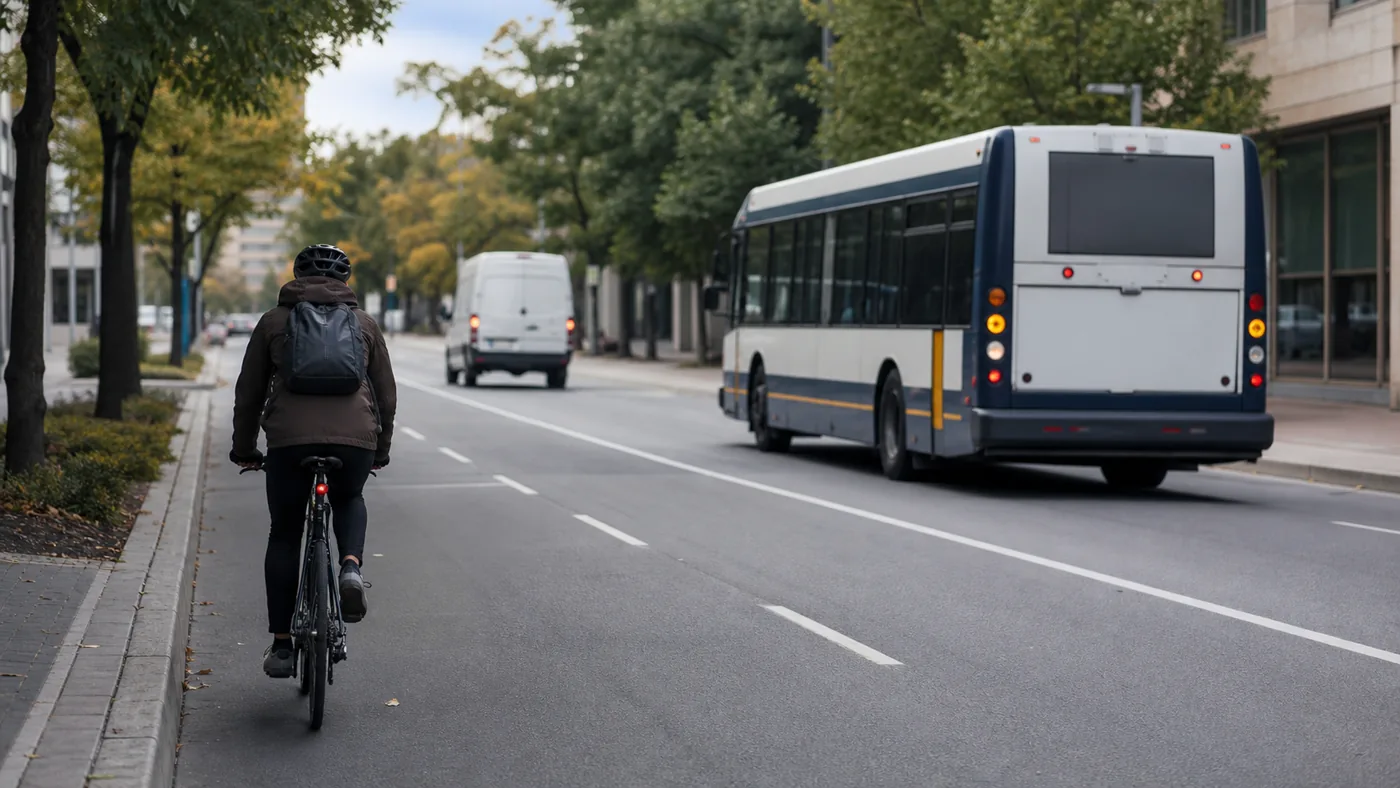
A cyclist may take the full lane; pass wide, wait for a real gap, and do not cut back in early.
Shoulder check before every right turn, because that is where cars and bicycles meet.
If you cannot see the mirrors of a truck, its driver cannot see you.
Trucks swing left before turning right, so never move up their right side.
School bus amber flashing means prepare to stop; red flashing with the stop arm out means stop until the lights go off.
Emergency vehicle with lights and siren: clear any intersection, then pull right and stop.
Approaching a stopped emergency vehicle, slow down and move over a lane where you safely can.
People on foot
A person walking has no bodywork, no seatbelt and no airbag, which is the whole reason the rules lean their way. Yield to pedestrians in a crosswalk, whether or not it is painted, and wait until they are safely across before you move through. At a crossing where lights or a guard control the traffic, the instruction is to stay stopped while anyone is still in the crossing, including a school crossing guard who has stepped into the road.
Never pass a vehicle that has stopped at a crosswalk. The reason is simple and it is the single most useful thing in this section: that vehicle is stopped for a person you cannot see, and going around it puts you into the space they are walking through. The same logic applies to a bus or a large vehicle stopped anywhere near a crossing.
Some pedestrians need extra room and extra time. A person using a white cane or a guide dog is telling you they cannot see you, and a wheelchair, a walker or a stroller cannot hurry out of your way. Children act unpredictably near roads and are short enough to disappear behind a parked car. Older adults may need longer than a signal allows. None of that requires a special rule, only that you stop early and stay stopped.
Cyclists and small wheels
A cyclist is a vehicle in traffic with the same right to the road as you and the same duty to obey signals and signs. They may take the full lane where the lane is too narrow to share, where they are avoiding an opening door, or where the surface at the edge is broken, and that is the safe thing for them to do rather than an act of provocation.
Three situations produce most car and bicycle collisions. The first is the opening door, which is why cyclists ride away from parked cars and why you check over your shoulder before opening yours. The second is the right turn made across a cyclist coming up beside you, which is why the shoulder check before a right turn matters so much. The third is the left turn across an oncoming cyclist, whose speed is easy to underestimate because a bike looks small and therefore far away.
When you pass a cyclist, leave a wide margin, wait for a genuine gap rather than squeezing past, and do not cut back in early. Several provinces have written a minimum passing distance into law and the figure is not the same everywhere, so check the guide for yours. Do not drive or park in a bike lane, and where the paint tells you to yield before crossing one, yield.
Motorcycles and large vehicles
A motorcycle is entitled to a full lane and needs it, because riders move within the lane to stay visible and to avoid gravel, ruts and oil. Two things make motorcycles dangerous to be near: they hide easily in the areas your mirrors miss, and a small headlight approaching is hard to judge, so riders arrive sooner than drivers expect. Look twice for them before turning left and before changing lanes.
Trucks and buses have the opposite problem. They are impossible to miss and easy to misjudge. A loaded truck takes a long distance to stop, has large areas along both sides and directly behind where the driver cannot see you, and swings wide to the left before making a tight right turn. If you cannot see the mirrors of a truck, its driver cannot see you. Never try to squeeze up the right side of a truck that is turning right.
Give heavy vehicles room in front as well as behind. Cutting into the gap a truck driver has left in front of them takes away the stopping distance they need for a vehicle that may weigh many times what yours does. Spray from a truck in the rain can blind you completely for a moment, which is another reason to pass decisively rather than sit alongside.
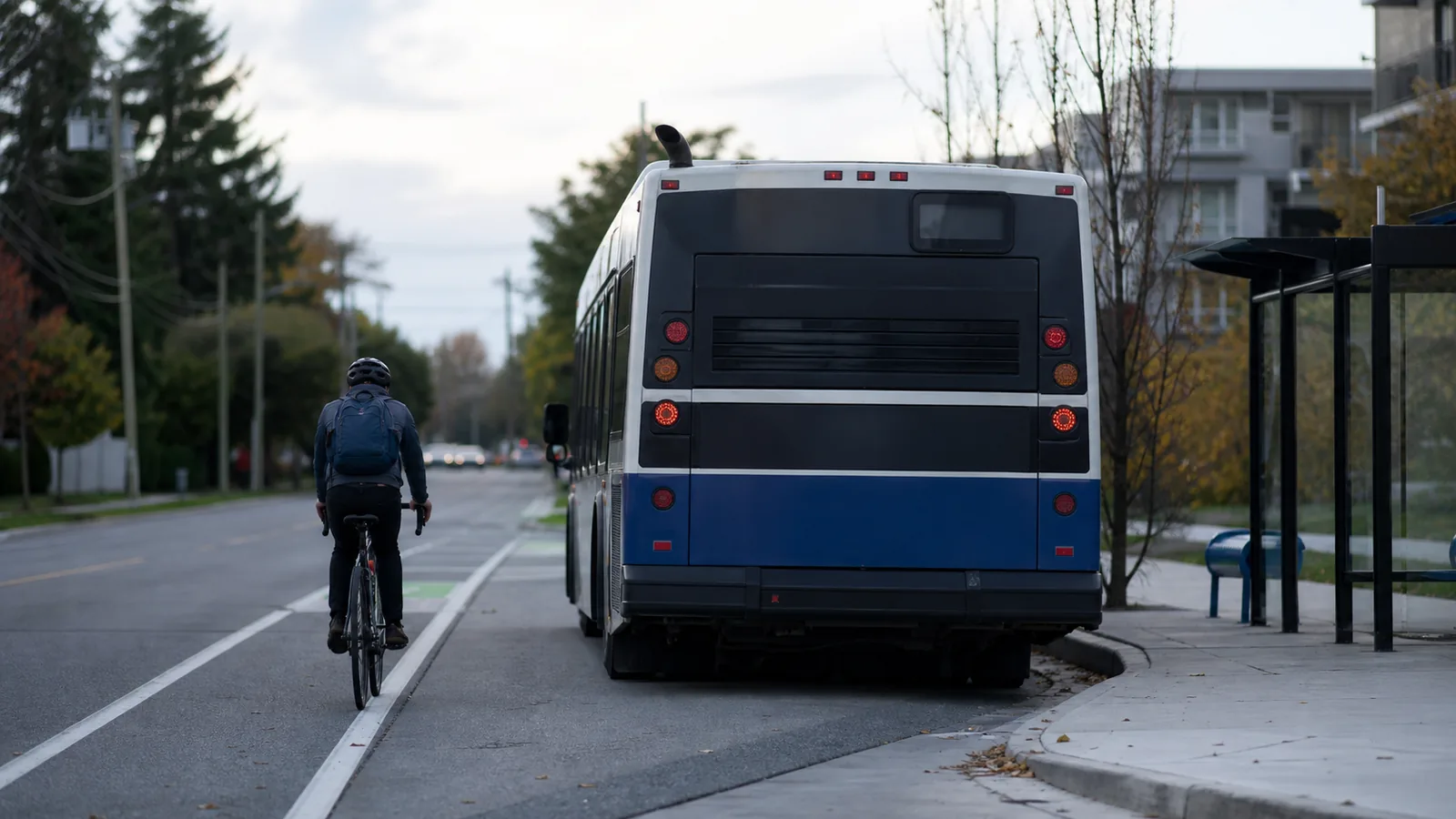
A bus stopped at a curb bulb and a cyclist passing on its left. This is the moment two rules meet, and it is the moment the test asks about.
School buses
A school bus signals in stages, and the stages tell you what to do. Amber lights flashing means the bus is about to stop and children are about to appear: slow down and prepare to stop. Red lights flashing, usually with a stop arm swung out, means stop and stay stopped until the lights go off and the arm folds back in. Children may cross in front of the bus where neither you nor the bus driver can see them well.
On an ordinary two way road, traffic in both directions stops for flashing red lights. Where a road is divided by a median or a physical barrier, drivers travelling in the opposite direction may not have to stop, and the exact wording of that exception differs across the country. It is one of the details most worth checking in the guide for your own province, because the consequence of getting it wrong is a child stepping out in front of a moving car.
Passing a stopped school bus with its red lights flashing is never allowed in any direction where the stopping rule applies. Waiting a few extra seconds costs nothing. The children crossing are the reason the entire signal system exists.
Stopping for a school bus
Your vehicle
Another vehicle
Where it goes
Flashing red lamps stop traffic both ways on a road with no median, while a median keeps the far side moving.
Emergency vehicles, work zones and slow moving traffic
When an emergency vehicle approaches with lights and siren, from any direction, pull as far to the right as you safely can, stop, and let it pass. If you are in an intersection when you hear it, clear the intersection first and then pull over, because stopping in the middle blocks the route. Do not follow an emergency vehicle closely to use the space it opens, and do not race to a spot before pulling in.
A second rule applies to emergency vehicles that are already stopped at the roadside with lights flashing, along with tow trucks and roadside crews in many provinces. Slow down as you approach and, on a road with more than one lane going your way, move over to leave an empty lane between you and them where you can do so safely. The required speed and the vehicles the rule covers are set provincially, so check yours.
Work zones deserve the same care. A flag person directing traffic is giving you an instruction that overrides the normal signs and markings, and you follow it. Slow moving vehicles, farm machinery and horse drawn buggies carry an orange triangle on the back, and closing speed on one of those is far higher than it looks from a distance. Slow early and pass only where you have room and clear sight ahead.
Making room for an emergency vehicle
Your vehicle
Another vehicle
Where it goes
The point they meet
Pull as far right as you safely can and stop, and never stop inside an intersection to do it.
What British Columbia does differently
Everything above holds across Canada. This part does not, and it is the part a British Columbia examiner can ask about.
British Columbia rule
Buses, bikes and heavy trucks
Transit buses have a legal claim on the lane here. When a bus at a stop signals to pull back into traffic, a driver in the lane beside it has to yield, as long as the bus has signalled and the move can be made safely. Drivers arriving from other provinces often do not know this rule, and it turns up on the knowledge test.
Cycling volumes on the coast are high and the infrastructure is mixed: painted lanes, protected lanes and ordinary shared streets, sometimes on one trip. Before any right turn, look through the right mirror and over your shoulder for a rider going straight through the space you are about to cross. When you park on a street with a bike lane, open the door with your far hand so your body turns and your eyes go back down the lane. Give a rider the room of a full lane change when you pass.
Heavy trucks on grades need space. They lose speed climbing and they need long distances to stop when loaded and heading down. Passing one and then braking for an exit is how people get hurt. Logging and gravel trucks on rural routes throw stones, so sit further back than feels necessary.
School bus red lights work as they do elsewhere in the country. On an undivided road, traffic stops in both directions. Where a median or barrier divides the road, only traffic behind the bus has to stop.
Where people get this wrong
What people think
The car ahead stopped for no reason, so I can go around it.
What is actually true
Near a crossing, a stopped vehicle is stopped for a person you cannot see yet. Going around it drives you straight into the space that person is walking through.
What people think
Cyclists should stay tight to the curb.
What is actually true
The edge holds broken pavement, drains and opening doors. A cyclist taking the lane is choosing the safer position, and your job is to pass wide or wait.
What people think
Traffic coming the other way never has to stop for a school bus.
What is actually true
On an ordinary two way road both directions stop. The exception is for roads divided by a median or barrier, and the wording of that exception is provincial, so read the one that applies to you.
What people think
I can pull into any gap in front of a truck.
What is actually true
That gap is the distance the truck needs to stop, and a loaded truck needs a great deal of it. Taking the space away is how a car ends up under one.
What people think
When an emergency vehicle comes, stop right where you are.
What is actually true
Stopping in an intersection or in a live lane blocks the route. Clear the intersection, then pull to the right and stop where the vehicle can get past you.
Check yourself
Three questions from the British Columbia bank on sharing the road. Answer them in your head first, then open the answer to see the rule it comes from.
Sharing the road1 of 3
A school bus stopped on the other side of an undivided two lane road has its red lights flashing as you approach.
ACarry on slowly, since the rule applies only to traffic behind the bus
BStop before you reach it and stay stopped until the lights stop flashing and the bus moves off
CPass at walking pace with your hazard lights on
DStop only if you can see children on the road
Show the answer
The answer is B. Stop before you reach it and stay stopped until the lights stop flashing and the bus moves off
Flashing red lights mean children are getting on or off, and they often cross in front of the bus where nobody can see them. On an undivided road, traffic in both directions stops and waits. Stop well back so you can see the whole area around the bus before you move again.
Motor Vehicle Act (British Columbia)
Sharing the road2 of 3
You are on a highway split by a raised median, and a school bus on the far side has its red lights flashing.
AStop, because the rule is the same on every road
BStop, but only in the lane nearest the median
CCarry on with care, because the median separates you from the bus and its passengers
DStop, then pass the bus at low speed
Show the answer
The answer is C. Carry on with care, because the median separates you from the bus and its passengers
The stopping rule protects children crossing the road to reach the bus, and a raised median or barrier means nobody is crossing to your side. Painted lines alone do not divide a road for this purpose, so look for a real physical separation. Where you are not sure, stopping costs you nothing.
Motor Vehicle Act (British Columbia)
Sharing the road3 of 3
A cyclist is riding ahead of you in a narrow lane and traffic is coming the other way.
APass inside the lane, hugging the centre line as you go by
BSound your horn so they move onto the shoulder
CDrive close behind until the cyclist pulls over
DStay back and pass only when you can give a wide berth, changing lanes or using the other side when it is clear
Show the answer
The answer is D. Stay back and pass only when you can give a wide berth, changing lanes or using the other side when it is clear
A cyclist needs room to swerve around a drain, a pothole or a car door swinging open, and a close pass takes that room away. If the lane is too narrow to share, treat the bike as a vehicle and pass it the way you would pass a car. A horn startles a rider and often pushes them exactly where you do not want them.
Motor Vehicle Act (British Columbia)
Now go and answer some questions
The British Columbia bank holds 5 questions on sharing the road. Answering them now, while the lesson is fresh, is how you find the parts that only felt clear.
We use Google Analytics and Microsoft Clarity to see which pages help learners, and advertising cookies to keep the site free to use. Accept to allow them, or decline. How your data is handled