British Columbia asks about parking and stopping in 5 of our questions. Where you may not leave a vehicle and why, the difference between stopping and parking, how to parallel park in steps, and what to do with the wheels when you park on a hill.
About 7 minutes to read5 British Columbia questions on this1 diagramLast reviewed 2026-08-27
Worth remembering
No stopping, no standing and no parking mean three different things; no stopping is the strictest.
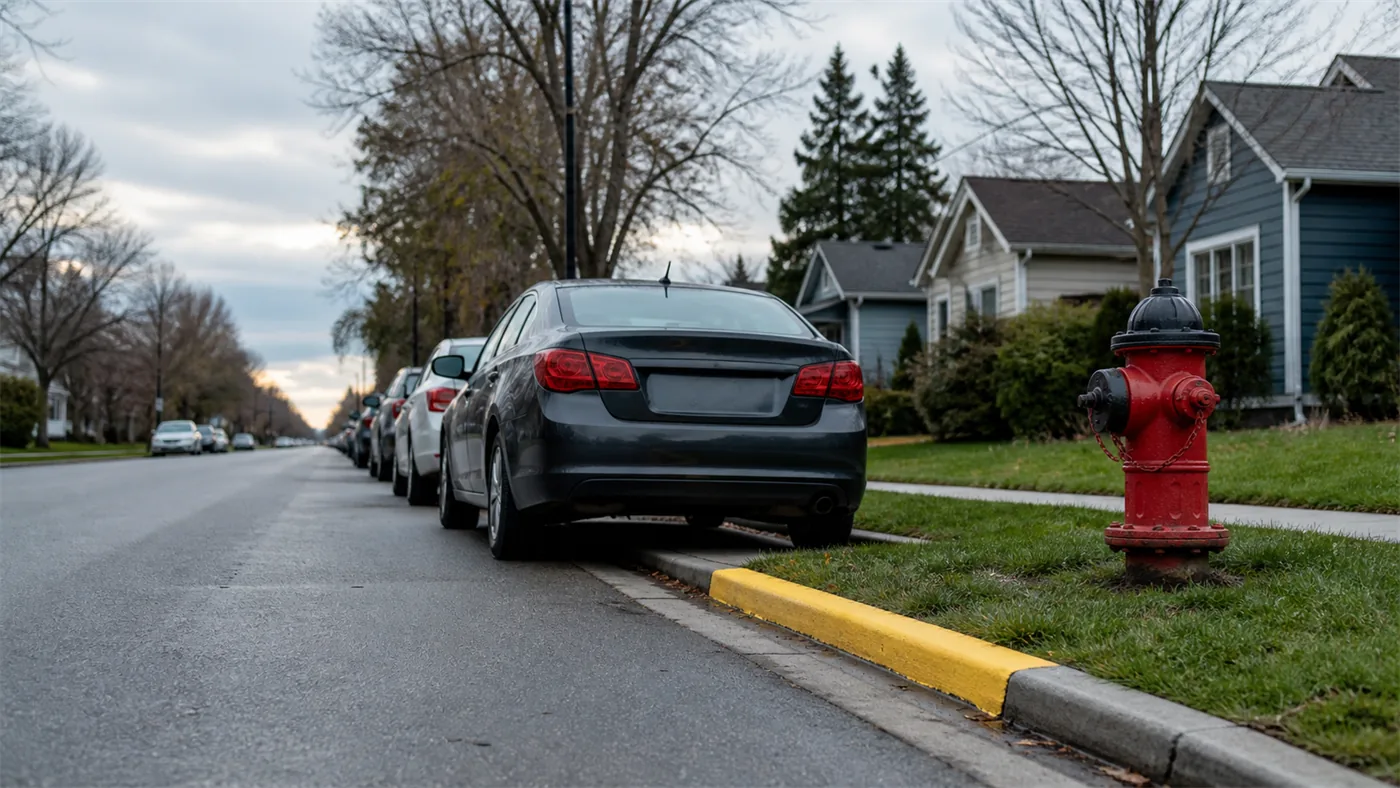
Keep clear of hydrants, crosswalks, sidewalks, driveways, intersections, bus stops, bike lanes and railway crossings.
The measured distances behind those rules are provincial. Learn the ones in the guide for your province.
Do not park facing against traffic, and do not stop on the travelled part of a highway if you can get off it.
Parallel park in order: position, reverse turning toward the curb, straighten, then bring the front in.
Downhill, wheels toward the curb. Uphill with a curb, wheels away and roll back to touch. No curb, wheels toward the edge.
Set the parking brake every time, and never leave a child or an animal alone in the vehicle.
Check your mirror and look over your shoulder for cyclists before opening the door.
Stopping, standing and parking are three different things
Signs use these words precisely, and the test does too. No stopping means do not halt the vehicle there at all, even for a moment, except when traffic or a police officer forces you to. No standing means you may pause only long enough to let a passenger get in or out, and you stay with the vehicle. No parking is the mildest of the three: you may stop briefly to load or unload people or goods, but you may not leave the vehicle sitting there.
The reason the wording matters is that a no stopping sign usually marks a place where a halted vehicle is genuinely dangerous, such as a spot that hides a crossing or narrows a lane on a bend, while a no parking sign marks a place that simply needs to stay clear. Read the sign, read the arrows on it, and read the times printed under it, because many restrictions apply only during certain hours or certain months.
Places you may not leave a vehicle
The list is close to identical across the country, even though the measured distances behind it are provincial. Do not stop or park where you would block a fire hydrant, a crosswalk, a sidewalk, a driveway, an intersection, a bus stop or a bike lane. Keep clear of railway crossings, bridges, tunnels and the space beside another parked vehicle, since double parking pushes a whole lane of traffic around you. Do not park where a sign or a painted curb forbids it, and never in a space marked for accessible parking unless the vehicle displays the permit that space is for.
Two more that catch people out: do not park facing against the direction of traffic on a two way road, and do not park on the travelled part of a highway if there is any way to get off it. If you must stop on a rural road, get as far onto the shoulder as you safely can, leave the road visible from both directions, and turn on your hazard lights.
The exact distances you must keep from a hydrant, a corner or a crossing are set by each province and sometimes by the city, and they are the kind of number that changes. Learn the ones printed in the guide for your own province, and treat the sign or the painted curb in front of you as the authority on that particular spot.
Parallel parking, one step at a time
Parallel parking is a sequence, and it works every time if you do it in order rather than by feel. Find a space noticeably longer than your vehicle. Signal, check your mirrors and your blind spot, and stop beside the vehicle in front of the space, roughly level with it and about an arm span out from it. Put the car in reverse and check over both shoulders and through the back window, because everything that happens next happens behind you.
Reverse slowly and turn the wheel toward the curb so the back of your car swings into the space. When your vehicle sits at an angle across the opening and you can see the headlights of the car behind through your rear window, straighten the wheel and keep reversing until your front bumper clears the vehicle in front. Then turn the wheel the other way to bring the front of the car in, and stop before you touch the vehicle behind.
Finish by centring yourself in the space, close and parallel to the curb, then set the parking brake and put the vehicle in park or in gear. If it did not come out right, that is normal. Pull forward, adjust, and try again. Examiners expect adjustment; what they do not want to see is a driver who reverses without looking behind or who touches another vehicle or the curb hard.
Parallel parking, step by step
Your vehicle
Another vehicle
Where it goes
Line up beside the car in front of the space, reverse in on an angle, then straighten and bring the front in.
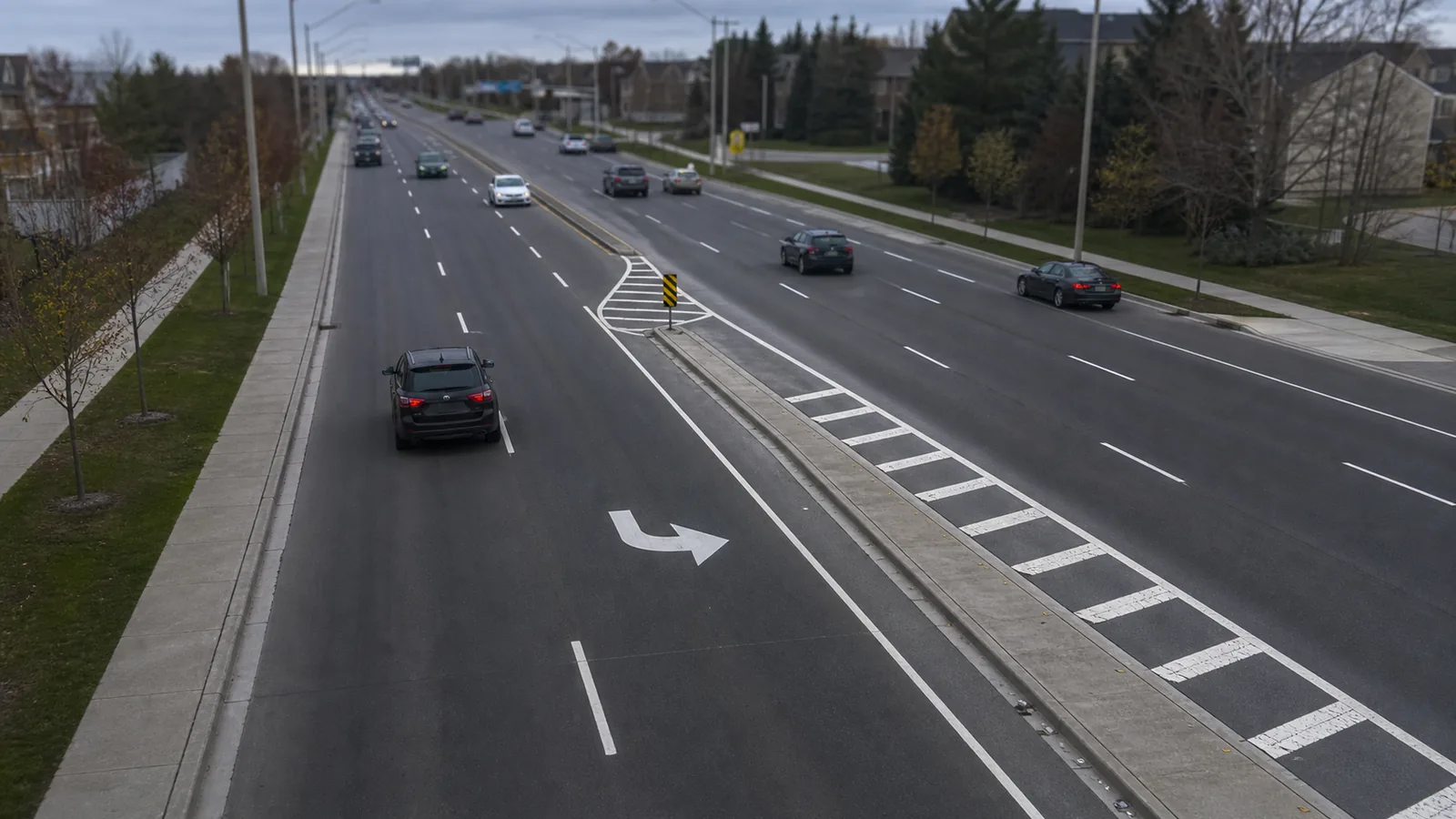
A marked left turn bay and a painted island, seen from above. Most of what a knowledge test asks about is painted on the road rather than posted beside it.
Hills, and leaving the vehicle safely
A parked car should not be able to roll into traffic, and the front wheels are what stop it. Facing downhill, turn the front wheels toward the curb, so that if the car creeps it rolls into the curb and stops. Facing uphill with a curb, turn the wheels away from the curb and let the car roll back until a wheel rests against it. Where there is no curb at all, turn the wheels toward the edge of the road in either direction, so that any movement takes the car away from the traffic lane.
Always set the parking brake, and leave an automatic in park or a manual in gear. Turn the engine off, take the key, and lock up. Never leave a child or an animal alone in a parked vehicle: an interior heats up dangerously fast in the sun, and the risk in a Canadian winter runs the other way.
Getting out is the last hazard and the one drivers forget. Check your mirror, then look over your shoulder for a cyclist before you open the door, and open it only as far as you need. Opening the door with the hand furthest from it turns your body toward the traffic naturally and makes that look automatic. Passengers, especially children, get out on the curb side.
Where you park and what happens next
Angle parking, common in lots and on some main streets, is easy to enter and awkward to leave, because you back out with your view blocked by the vehicles beside you. Reverse very slowly, edge back until you can see past them, and expect somebody to be moving behind you. Backing into the space instead, where it is allowed, turns the difficult part into the easy part.
Winter parking has rules of its own in many municipalities: overnight bans while ploughs work, alternating sides on certain dates, and towing when snow clearing starts. These are local, they change from one city to the next, and the fine and the towing are both real. Check the local rules wherever you leave a car overnight in winter.
British Columbia and this topic
British Columbia
British Columbia follows the same rules on this topic
Nothing above changes when you cross into British Columbia, so there is no separate British Columbia version of this lesson to read. The stages, the fees and the format of the test are the numbers that do change, and those sit on the British Columbia page with the source behind each one.
The 5 practice questions on this topic in the British Columbia bank are written for British Columbia, and each one shows the authority it comes from when you answer it.
No parking still allows a brief halt to load or unload while you stay with the vehicle. The sign that forbids halting at all is no stopping, and it is used where a halted vehicle is a hazard.
What people think
Hazard lights make it fine to stop anywhere.
What is actually true
Hazard lights warn other drivers; they do not create a legal parking space. Stopping in a no stopping area or in a live lane stays an offence and stays dangerous.
What people think
Parking brake is only for manual cars or steep hills.
What is actually true
It is for every vehicle, every time. The parking pawl in an automatic is a small part holding a heavy car, and the brake is what keeps the load off it.
What people think
Curbing the wheels is a driving school detail nobody checks.
What is actually true
It is a rule in provincial law and it is scored on road tests, because a driverless car rolling into a lane is a serious event. Downhill toward the curb, uphill away from it.
What people think
Nobody is behind me, so I can open my door.
What is actually true
A cyclist can cover a lot of ground in the time it takes to unbuckle. Mirror, shoulder check, then open, and reaching across with the far hand makes that look automatic.
Check yourself
Three questions from the British Columbia bank on parking and stopping. Answer them in your head first, then open the answer to see the rule it comes from.
Parking and stopping1 of 3
You park facing downhill on a street with a curb. Which way do you leave the front wheels?
AStraight ahead, with the parking brake set
BTurned toward the curb, so the vehicle would roll into it if it moved
CTurned away from the curb, so it would roll into the lane
DIt makes no difference as long as the transmission is in park
Show the answer
The answer is B. Turned toward the curb, so the vehicle would roll into it if it moved
Turning the wheels toward the curb gives the car something solid to stop against if the brake or the transmission lets go. Facing downhill, gravity pulls the front of the car forward, so the front tires need to be pointing at the curb. The parking brake still goes on, because the wheels are the backup and not the plan.
Motor Vehicle Act (British Columbia)
Parking and stopping2 of 3
You stop on a steep gravel road with no curb at all. How should the front wheels be left?
AStraight, so the vehicle stays in line if it moves
BPointed toward the middle of the road, so oncoming traffic can see you
CTurned so the vehicle would roll off the road rather than into the lane
DWheel position does not matter where there is no curb
Show the answer
The answer is C. Turned so the vehicle would roll off the road rather than into the lane
With no curb the only place a rolling vehicle can be aimed is away from other traffic, so the front wheels point toward the shoulder or the ditch. That holds facing up the slope and facing down it. Set the parking brake firmly and leave an automatic in park, or a manual in gear.
Motor Vehicle Act (British Columbia)
Parking and stopping3 of 3
You pull into a marked bus stop zone for a moment to let a passenger out. No bus is in sight.
ANot allowed, a bus stop zone is kept clear so a bus can bring its doors to the curb
BAllowed, because stopping briefly is not parking
CAllowed as long as you stay with the vehicle
DAllowed outside the hours shown on the sign only
Show the answer
The answer is A. Not allowed, a bus stop zone is kept clear so a bus can bring its doors to the curb
A bus has to reach the curb so passengers, including anyone using a ramp, can get on and off at the sidewalk. A car in the zone forces the bus to unload in the traffic lane instead. Dropping someone off counts as using the zone, with the engine running or not.
Motor Vehicle Act (British Columbia)
Now go and answer some questions
The British Columbia bank holds 5 questions on parking and stopping. Answering them now, while the lesson is fresh, is how you find the parts that only felt clear.
We use Google Analytics and Microsoft Clarity to see which pages help learners, and advertising cookies to keep the site free to use. Accept to allow them, or decline. How your data is handled