Alberta asks about passing and lanes in 6 of our questions. Choosing a lane, changing lanes without surprising anyone, passing on a two way road, and joining a highway at the speed of the traffic already there.
About 7 minutes to read6 Alberta questions on this3 diagramsLast reviewed 2026-08-27
Worth remembering
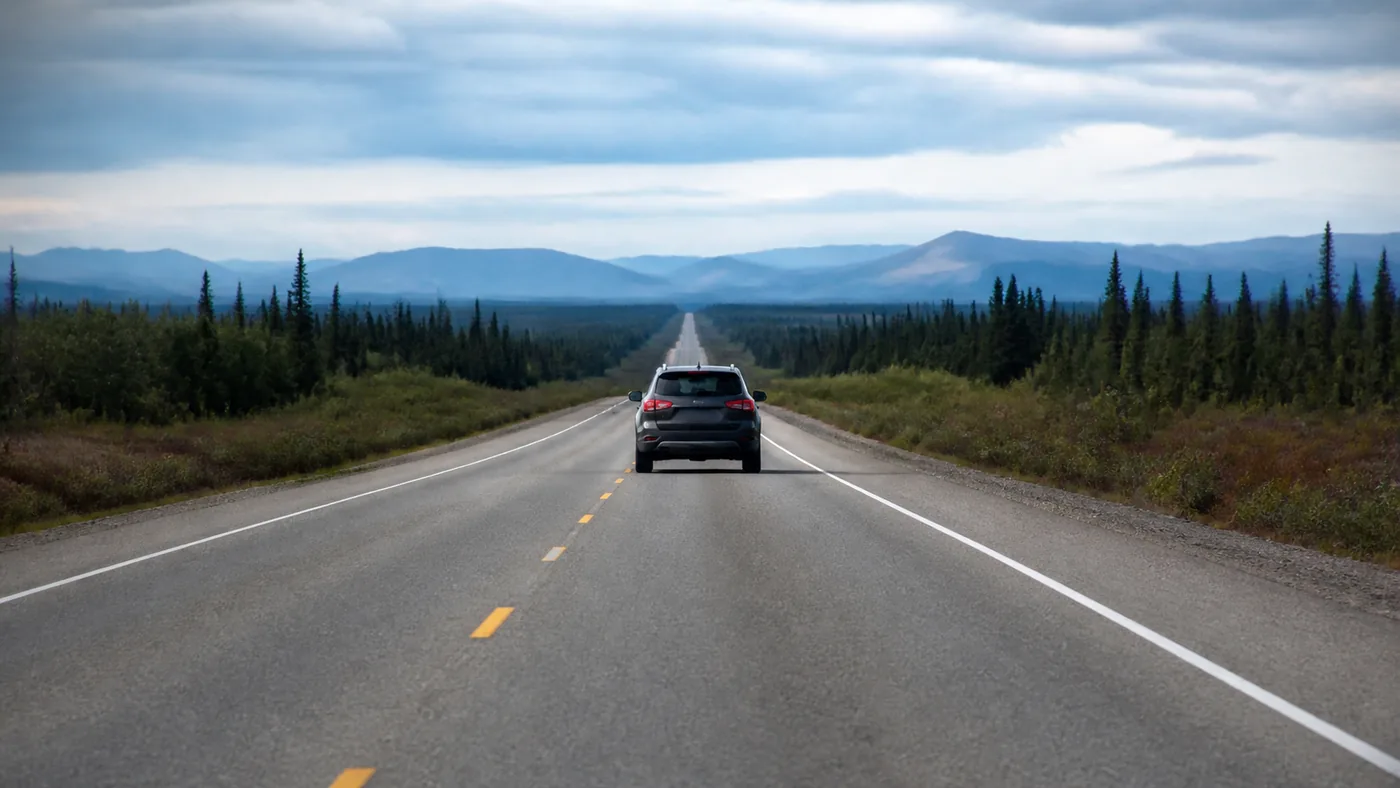
Broken line on your side means passing is allowed; solid on your side means it is not, whatever the other side shows.
Keep right except to pass, and use the arrows painted on the lane to choose your lane early.
Mirror, signal, mirror, blind spot head check, then move. One lane at a time.
A signal tells other drivers your plan. It does not create a gap or give you the right to take one.
Do not pass unless the line, the signs, the sight distance and the road ahead all allow it.
Join a highway at the speed of the traffic already on it, and do not stop at the end of an acceleration lane.
Where a lane ends, use its full length and take turns one for one at the merge point.
Return to your lane after passing a large vehicle only when you can see it in your interior mirror.
Reading the lines and choosing a lane
Road markings are instructions. A broken line may be crossed when it is safe. A solid line beside you means stay where you are. A double solid line between opposing traffic means neither direction may cross to pass. Where you see one solid and one broken line together, the rule applies to the side you are on: broken on your side means you may pass, solid on your side means you may not, even though the driver coming the other way is allowed to.
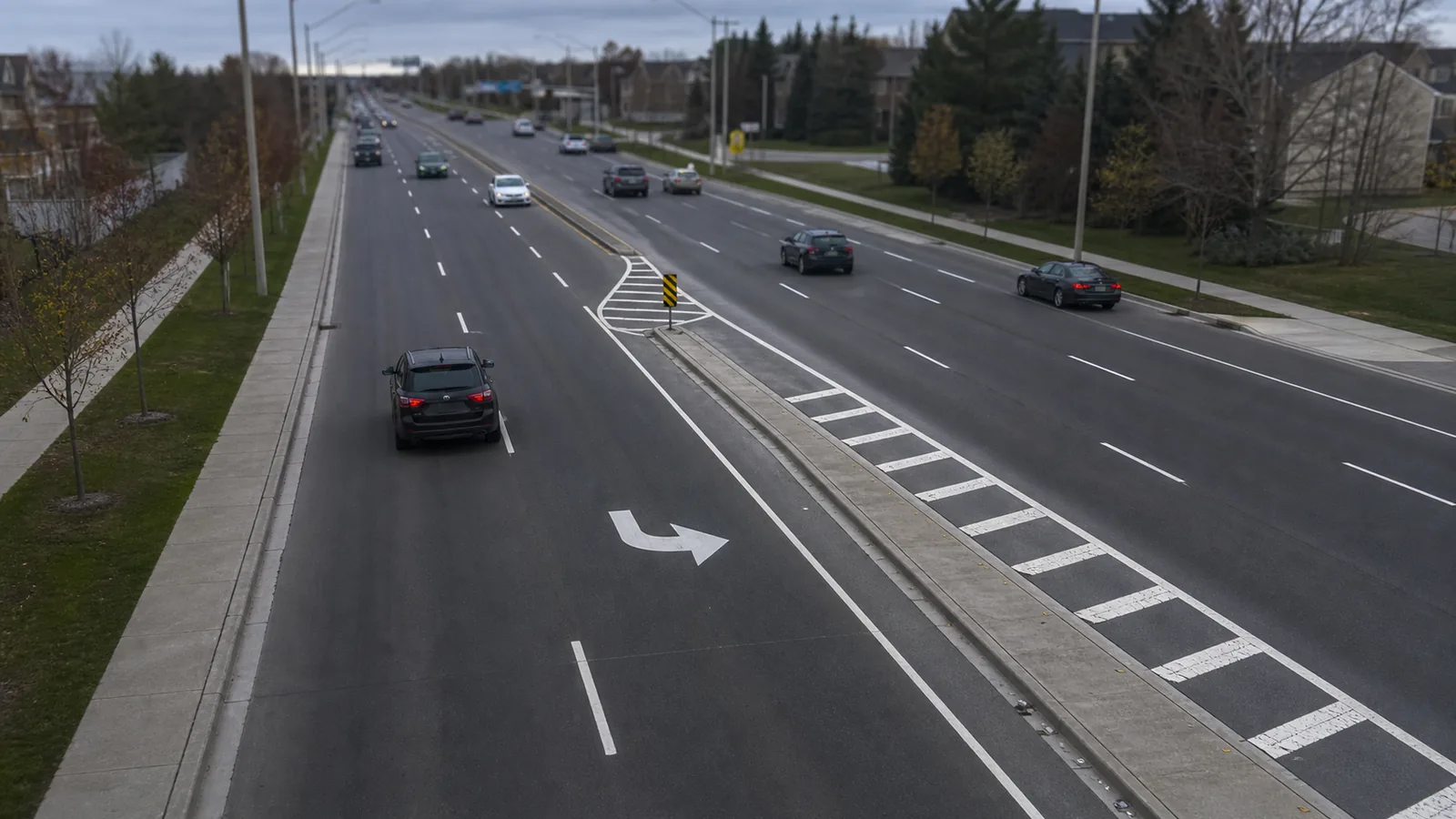
Lane choice on a multi lane road follows one simple habit: keep right except to pass. The left lane is for passing and for turning left, and sitting in it at the same speed as the traffic beside you creates the frustration that produces risky passes further back. Where lanes are marked with arrows, the arrows govern, so read them early and move across in good time.
Inside your own lane you have room to position yourself. Move a little away from a row of parked cars so an opening door cannot reach you, a little away from a cyclist while you pass, a little away from an oncoming truck on a narrow road, and out of the deep ruts and slush where the surface is worst. None of that requires leaving your lane. Small adjustments buy you room, and room buys you time.
Which lane to be in
Your vehicle
Another vehicle
Where it goes
Keep right for through traffic, use the left lane to pass or turn left, and move back over once you are past.
Changing lanes without surprising anyone
A lane change has an order and the order is what makes it safe. Check your mirror to see the traffic behind, signal in time for other drivers to understand what you plan, check the mirror again, turn your head to look in the blind spot on the side you are moving toward, and only then move over smoothly and cancel the signal.
The head check is not optional and it is not a glance in the mirror. Every car has areas along its rear quarters that no mirror covers, and a whole motorcycle or a small car can sit in one of them. Mirrors set wide, so that you see slightly beyond the side of your own car rather than the side of your own car, shrink those areas but never remove them.
Signal early enough to be useful, but treat your own signal as information rather than permission. Other drivers do not always give way, and a signal does not create a space. Make the move only once you can see the space is there, and never change more than one lane at a time, because a driver two lanes over cannot follow what you are doing.
What the mirrors miss
Your vehicle
Another vehicle
A wedge on each side of the car never appears in any mirror, so a shoulder check is the only way to see it.
Passing on a two way road
Passing on an ordinary two way road is the most demanding thing an average driver does, because it puts you in the path of oncoming traffic on purpose. Before you commit, four things must be true: the line on your side allows it, no sign forbids it, you can see far enough ahead to complete the pass and return with room to spare, and there is nothing about the situation ahead, such as a crest, a curve, an intersection or a crossing, that could hide a vehicle from you.
You pass on the left as a rule. Passing on the right is allowed only in limited situations, such as a road with two or more lanes going your way, or where the vehicle ahead has moved left and signalled a left turn, and never by using the shoulder. Once you begin, use a firm and steady speed, keep the whole move short, and return to your lane only when you can see the vehicle you passed in your interior mirror.
Judging oncoming closing speed is the part people get wrong, because two vehicles approaching each other close the gap far faster than either one is travelling. If there is any doubt, do not pass. Almost nothing is achieved by getting past one vehicle, and the road will offer a proper opportunity soon enough.
A marked left turn bay and a painted island, seen from above. Most of what a knowledge test asks about is painted on the road rather than posted beside it.
Merging and lanes that end
Joining a highway means using the ramp and the acceleration lane to get to the speed of the traffic already on the road, checking over your shoulder for a gap, and blending in. Stopping at the end of an acceleration lane is dangerous and is nearly always a mistake, because the traffic behind expects you to be moving and the gap you need is much larger from a standstill.
Drivers already on the highway have a part to play too. Where it is safe, ease off slightly or move over a lane to make room for a vehicle joining, rather than closing the gap. This costs almost nothing and prevents the sudden braking that ripples back through traffic.
When a lane ends, traffic in the ending lane merges into the lane that continues. The orderly version is to use the full length of the ending lane, then take turns one for one where the lanes meet. That is faster for everybody than merging early into a solid line of vehicles, and it is what the diagram shows. Signal, match speed, and slot in without forcing anyone to brake hard.
Joining a highway from a ramp
Your vehicle
Another vehicle
Where it goes
Use the whole acceleration lane to reach the speed of the traffic, then move into a gap you picked early.
Around big vehicles and in bad places to pass
Passing a large truck or a bus takes longer than passing a car and puts you alongside a vehicle with much bigger blind areas. Do not sit beside one. Get past decisively, and do not cut back in until you can see its whole front in your interior mirror, because a loaded truck needs a long distance to stop and you have just taken part of it away.
Some places are simply the wrong ones to pass: approaching an intersection or a railway crossing, near a pedestrian crossing, on a bridge or in a tunnel where there is no room, in a school or playground zone, and anywhere a sign forbids it. Where a stopped school bus is showing red flashing lights, you do not pass at all. The details of some of these are provincial, so read the list in the guide for your own province.
Alberta and this topic
Alberta
Alberta follows the same rules on this topic
Nothing above changes when you cross into Alberta, so there is no separate Alberta version of this lesson to read. The stages, the fees and the format of the test are the numbers that do change, and those sit on the Alberta page with the source behind each one.
The 6 practice questions on this topic in the Alberta bank are written for Alberta, and each one shows the authority it comes from when you answer it.
No mirror covers the area beside your rear quarters. That is exactly where a motorcycle or a small car hides, so the head check is the step that finds it.
What people think
Signalling gives me the right to move over.
What is actually true
A signal is information for other drivers, not a claim on the space. Look for the gap, confirm it is there, then move.
What people think
Merging early is polite.
What is actually true
Merging early wastes half the road and creates a long line in one lane. Using the ending lane fully and taking turns at the merge point moves everyone through faster and with less braking.
What people think
I can slide back in as soon as I am past the truck.
What is actually true
Cutting in close eats the space a heavy vehicle needs in order to stop. Wait until you can see the whole front of the truck in your interior mirror.
What people think
Passing on the right is fine if the driver ahead is slow.
What is actually true
Passing on the right is allowed only in narrow situations, such as a road with two or more lanes in your direction or a vehicle waiting to turn left. Using the shoulder to get by is not one of them.
Check yourself
Three questions from the Alberta bank on passing and lanes. Answer them in your head first, then open the answer to see the rule it comes from.
Passing and lanes1 of 3
You have checked your mirrors, signalled and seen a clear gap in the next lane. What still has to happen before you move across?
ANothing, mirrors and a signal cover it
BA tap on the brakes so the driver behind knows
CA second signal once you start moving
DA quick look over your shoulder into the blind spot on that side
Show the answer
The answer is D. A quick look over your shoulder into the blind spot on that side
Every mirror set leaves an area beside and slightly behind the vehicle where a car or a motorcycle can sit unseen. A short head turn is the only thing that clears it, and it has to be short, because the road ahead of you keeps moving while you look.
Alberta Driver's Guide (Government of Alberta)
Passing and lanes2 of 3
You are on the acceleration lane of a divided highway and the through lane beside you is busy. What should you do?
AStop at the end of the ramp and wait for a large gap
BBuild speed to match the traffic and merge into a gap before the lane runs out
CMerge at ramp speed straight away and let the traffic sort itself out
DDrive along the shoulder past the ramp until a gap appears
Show the answer
The answer is B. Build speed to match the traffic and merge into a gap before the lane runs out
An acceleration lane exists so you can arrive at the speed of the traffic, because a slow vehicle joining fast traffic forces everyone else to brake. Stopping at the end of it is worse still: you have no run up left, and the driver behind you on the ramp does not expect a stationary vehicle.
Alberta Driver's Guide (Government of Alberta)
Passing and lanes3 of 3
You have pulled out to pass on a two lane rural highway and an oncoming vehicle appears sooner than you expected. What is the right decision?
AHold the pass and expect the oncoming driver to use the shoulder
BFlash your lights so the oncoming driver slows
CEase off, drop back and return behind the vehicle you were passing
DAccelerate hard and squeeze in ahead
Show the answer
The answer is C. Ease off, drop back and return behind the vehicle you were passing
Two vehicles closing head on eat the gap at the sum of both speeds, so the space you judged a moment ago has already gone. Abandoning a pass costs a few seconds, and it stays available for as long as you are still behind the rear bumper of the vehicle ahead.
Alberta Driver's Guide (Government of Alberta)
Now go and answer some questions
The Alberta bank holds 6 questions on passing and lanes. Answering them now, while the lesson is fresh, is how you find the parts that only felt clear.
We use Google Analytics and Microsoft Clarity to see which pages help learners, and advertising cookies to keep the site free to use. Accept to allow them, or decline. How your data is handled