Ontario asks about speed and following distance in 6 of our questions. A posted maximum is a limit for good conditions, not a target. This lesson covers how speed changes what you can stop for, and how to judge the gap in front of you by counting rather than guessing.
About 7 minutes to read6 Ontario questions on this1 diagramLast reviewed 2026-08-27
Worth remembering
A posted maximum applies in good conditions. Conditions worse than good mean a lower safe speed, and the law expects that of you.
Speed limits, default limits and zone limits are provincial. Learn the ones for the province you are tested in.
Stopping is perception plus reaction plus braking, and braking distance grows much faster than speed does.
Drive so you can stop within the distance you can see to be clear on your own side of the road.
Judge your following gap by counting against a fixed object as the vehicle ahead passes it.
Grow the gap for rain, snow, ice, gravel, fog, darkness, heavy loads, trailers and large vehicles ahead.
Tailgated? Make more room in front, and let the other driver past when it is safe.
Driving far below the flow of traffic is a hazard too. Keep right and let traffic through.
What a speed limit is telling you
A speed sign gives the highest legal speed for that road in good conditions: dry surface, clear view, light traffic, a vehicle in sound order and a driver who is awake. Take any of those away and the safe speed drops below the number on the sign, while the number itself stays where it is. Every province writes this into its law in some form, usually as a duty to drive at a speed that is reasonable for the conditions, which is why a driver can be charged for driving too fast for a snowstorm while still under the posted maximum.
Limits themselves are provincial. The default speed for a road with no sign on it, the maximum on rural highways, and the special limits for school zones, playground zones and construction areas are set by each province and sometimes by the local municipality, so look them up for the place you are being tested in rather than carrying a number across a border. Speeding penalties in construction zones and school zones are heavier than elsewhere in most of the country.
On some curves and ramps you will see a smaller yellow tab under a warning sign showing a lower speed. That is an advisory speed for that feature, and it assumes good conditions too. Slow to it before you enter the curve, not while you are in it, because braking mid corner is where the grip runs out.
Why speed changes everything about stopping
Stopping is three things added together. First you have to notice the hazard. Then you have to react, which takes a moment while your foot moves. Only after that does the vehicle start to slow, and it keeps moving the whole time. Perception and reaction distance grow in a straight line with speed, but braking distance grows much faster than that, so a modest rise in speed makes a large difference to where you finally stop.
This is why the sensible way to think about speed is not the number on the sign but the distance to whatever you might have to stop for. Drive so that you can stop within the distance you can see to be clear, on your side of the road. Over a crest, around a bend, in fog and after dark, that distance shrinks, and your speed has to shrink with it.
The same physics explains why a heavier or loaded vehicle, a vehicle towing a trailer and a vehicle with worn tires all need more room. It also explains why the last part of a stop feels easy while the first part is where the damage happens: most of the energy is lost in the earliest, hardest part of the braking.
Judging the gap in front of you
The space in front of you is the only space you fully control, and it is the one that gives you time to notice, decide and brake. Judging it in car lengths does not work, because a car length is hard to picture at speed and the room you need changes with how fast you are going. Judging it in time does work, because the time it takes you to reach a fixed point is the time you have to react.
Here is the method. Pick a fixed object beside the road ahead: a sign post, a light standard, a painted line, the shadow of an overpass. When the back of the vehicle in front passes that object, start counting steadily. If you reach the same object before your count finishes, you are too close, so ease off and rebuild the gap. The guide for your province tells you the count to use in good conditions, and the number varies, so learn the one you will be tested on.
Then grow the count. Rain, snow, ice, loose gravel, fog, darkness, a heavy load, a trailer, worn tires, a long downhill and following a large vehicle whose spray or bulk blocks your view are all reasons to leave more time, and several of them together are reasons to leave much more. You will never regret the extra space. It also smooths out your driving, because a driver with room ahead brakes gently and rarely.
Counting your following distance
Your vehicle
Another vehicle
Where it goes
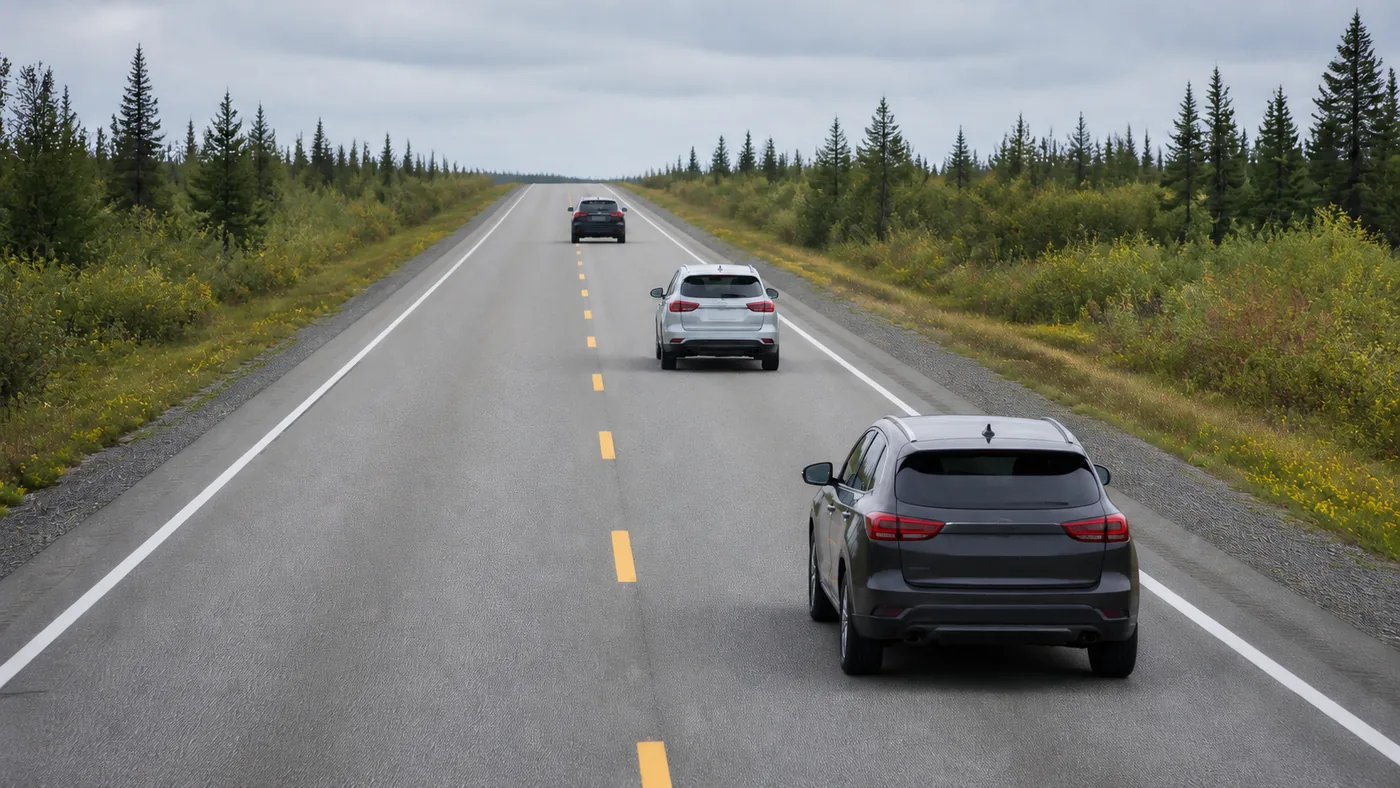
Pick a fixed object beside the road and count from the car ahead passing it to your own car reaching it.
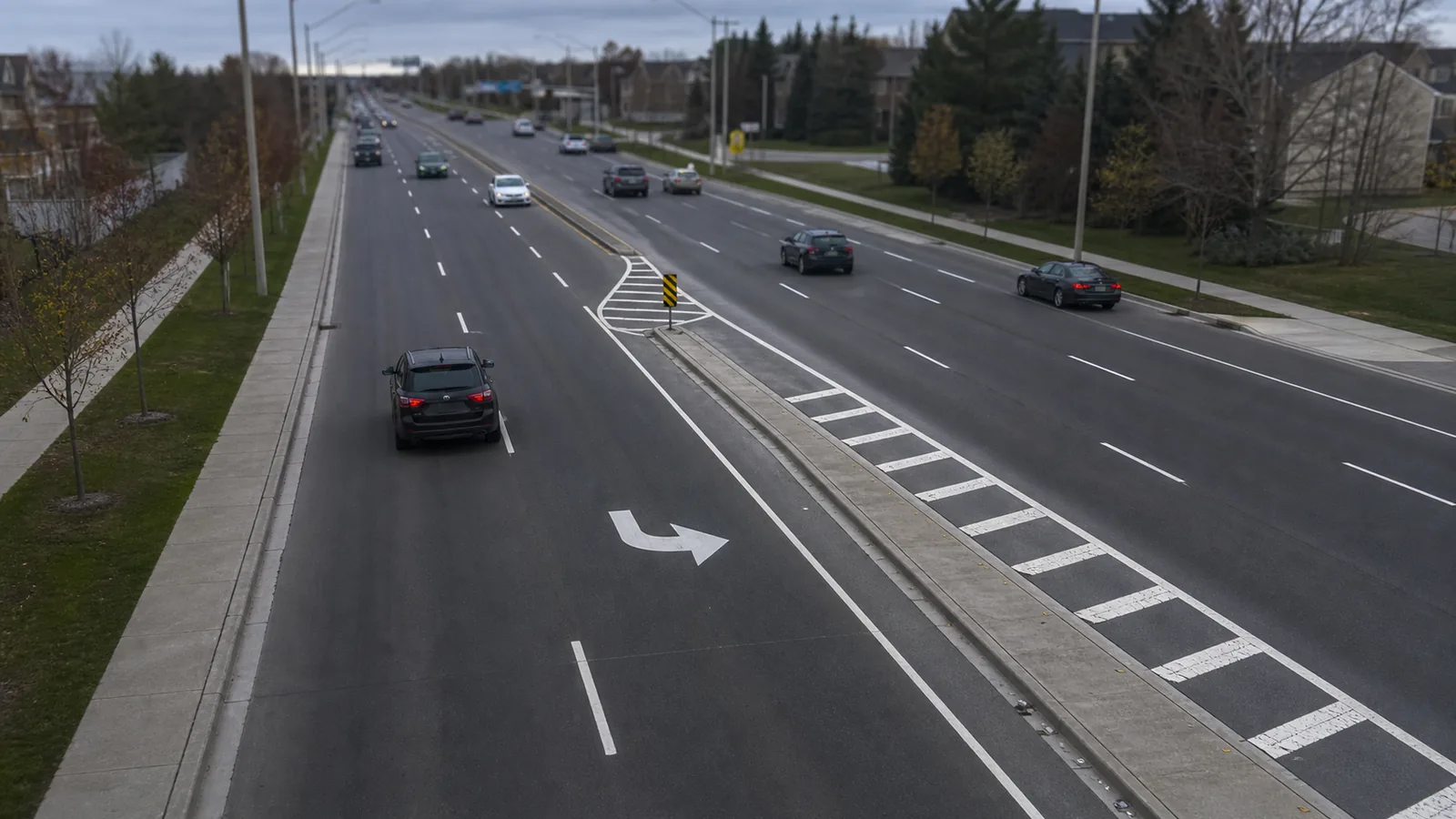
A marked left turn bay and a painted island, seen from above. Most of what a knowledge test asks about is painted on the road rather than posted beside it.
Being followed too closely, and moving with traffic
When somebody sits on your bumper, the instinct is to speed up or to brake at them. Both make it worse. The safer answer is to increase the gap in front of you, so that if you do have to slow, you can do it gradually and give the driver behind time to respond. Where it is safe and legal, let them past. Nothing about their impatience is your problem to solve at speed.
Driving well below the flow of traffic is its own hazard, because it forces other drivers to pass. Some roads carry a posted minimum speed for this reason, and every province has some rule about not obstructing traffic by driving unreasonably slowly. If your speed is well under the traffic around you, keep right, and use pull off areas on rural highways to let a line of vehicles through.
Speed also has to fall on ramps, in tight urban streets with parked cars, near schools and playgrounds when children are around, and through work zones where people are on foot beside live lanes. In those places, the safe speed is often much lower than anything posted, and the driver who slows early looks calm rather than slow.
Building the habit
Speed control on a road test is not judged by whether you touched the limit. It is judged by whether your speed suited the road, whether you got there smoothly, and whether you left yourself room. Examiners notice a driver who arrives at every situation already at the right speed, and they notice the one who arrives fast and brakes.
The way to practise is to check the gap deliberately every few minutes rather than only when something feels wrong. Count against a fixed object, adjust, and carry on. After a few weeks the count becomes a feeling, and the feeling is what keeps working when the test is over.
Ontario and this topic
Ontario
Ontario follows the same rules on this topic
Nothing above changes when you cross into Ontario, so there is no separate Ontario version of this lesson to read. The stages, the fees and the format of the test are the numbers that do change, and those sit on the Ontario page with the source behind each one.
The 6 practice questions on this topic in the Ontario bank are written for Ontario, and each one shows the authority it comes from when you answer it.
If I am under the posted limit, my speed is legal and safe.
What is actually true
The limit assumes good conditions. Provinces also require a speed that suits the actual conditions, so a driver can be at fault, and charged, for going too fast for snow, fog or traffic while still under the sign.
What people think
A couple of car lengths is enough of a gap at any speed.
What is actually true
Car lengths do not scale with speed and are hard to judge from the seat. Counting the time to a fixed object does scale, because what you actually need is time to notice and react.
What people think
Braking distance goes up in step with speed.
What is actually true
Reaction distance does, but braking distance grows far more steeply. That is why a small increase in speed produces a large increase in where you finally come to rest.
What people think
Tapping the brakes teaches a tailgater to back off.
What is actually true
It removes the little time they had and invites the collision you were worried about. Increase your own gap instead, and let them pass.
What people think
Slower is always safer.
What is actually true
Well below the flow of traffic forces other drivers to pass and creates conflict. Match the traffic within legal limits, keep right if you are slower, and use pull off areas on rural roads.
Check yourself
Three questions from the Ontario bank on speed and following distance. Answer them in your head first, then open the answer to see the rule it comes from.
Speed and following distance1 of 3
You turn from a main road onto a residential street inside a town, and there is no speed limit sign anywhere in sight.
AThe limit is 50 km/h unless a sign says otherwise
BThe limit is 40 km/h, the usual figure for residential streets
CThere is no limit until a sign sets one
DThe limit stays whatever it was on the road you turned off
Show the answer
The answer is A. The limit is 50 km/h unless a sign says otherwise
Ontario sets a default of 50 km/h inside cities, towns, villages and other built up areas, and 80 km/h on roads outside them, and those figures apply with no sign present. A municipality can post something lower, and many residential streets are posted lower, but it takes a sign to change it. When you see no sign at all, the built up area default is what you are held to.
Highway Traffic Act (Ontario)
Speed and following distance2 of 3
You want to check how far you are behind the car ahead on a dry road, so you pick a fixed object at the roadside such as a pole.
AKeep two car lengths for every 10 km/h of speed
BCount two seconds between the car ahead passing the pole and you reaching it
CCount one second, which is enough time to react on a dry road
DStay far enough back to read the plate of the car ahead
Show the answer
The answer is B. Count two seconds between the car ahead passing the pole and you reaching it
Start counting when the vehicle ahead passes the object and stop when your front bumper reaches it. Two seconds is the minimum on a dry road with a clear view. A gap measured in seconds stretches by itself as you speed up, which is why it beats counting car lengths, something almost nobody judges well at speed.
Highway Traffic Act (Ontario)
Speed and following distance3 of 3
You are following a loaded transport truck on a two lane highway and sitting at your usual two second gap.
AIncrease the gap, because you cannot see past the truck and its driver may not be able to see you
BTwo seconds is fine, since the truck needs longer to stop than you do
CMove closer so you can see around it more easily
DMove onto the shoulder to get a view past it
Show the answer
The answer is A. Increase the gap, because you cannot see past the truck and its driver may not be able to see you
Behind a large vehicle your view of everything ahead is gone, so your only warning of trouble is a set of brake lights. There is also a long blind spot directly behind a truck, and a driver who cannot see you cannot allow for you. Dropping back gives you sight lines and puts you where the mirrors work.
Highway Traffic Act (Ontario)
Now go and answer some questions
The Ontario bank holds 6 questions on speed and following distance. Answering them now, while the lesson is fresh, is how you find the parts that only felt clear.
We use Google Analytics and Microsoft Clarity to see which pages help learners, and advertising cookies to keep the site free to use. Accept to allow them, or decline. How your data is handled