Alberta asks about right of way in 6 of our questions. The order in which two drivers use the same piece of road. Learn it as a set of rules about yielding, because yielding is the thing you actually do.
About 7 minutes to read6 Alberta questions on this2 diagramsLast reviewed 2026-08-27
Worth remembering
Right of way is given, not taken. Every rule here is a rule about when to yield.
No signs and no lights: first to arrive goes first, and a tie means the driver on the left yields to the driver on the right.
A four way stop goes in order of arrival, and a tie is settled by yielding to the right.
Facing drivers arriving together: the one going straight goes before the one turning left.
Coming out of a driveway, alley or parking lot, you yield to road traffic and to people on the sidewalk.
At a T intersection the road that ends yields to the road that continues.
A pedestrian who has started to cross keeps the right of way until they are across.
Having the right of way is never a defence for driving into a collision you could see coming.
What right of way actually means
Right of way is not something you own. It is something one driver gives and another accepts. The rules tell you who is expected to give it in each situation, so that two drivers arriving at the same piece of road at the same moment do not both decide to go. Read every rule in this lesson as a rule about yielding, because yielding is the action you take with your hands and feet. Test questions are usually not asking who has priority in theory. They are asking what you should do.
That distinction matters more on the road than it does on paper. A driver who has the right of way and takes it without looking is still in the collision. Every province expects a driver to take reasonable care to avoid a crash, including one caused by somebody else. Being right is small comfort standing at the roadside waiting for a tow truck.
Intersections with no signs and no lights
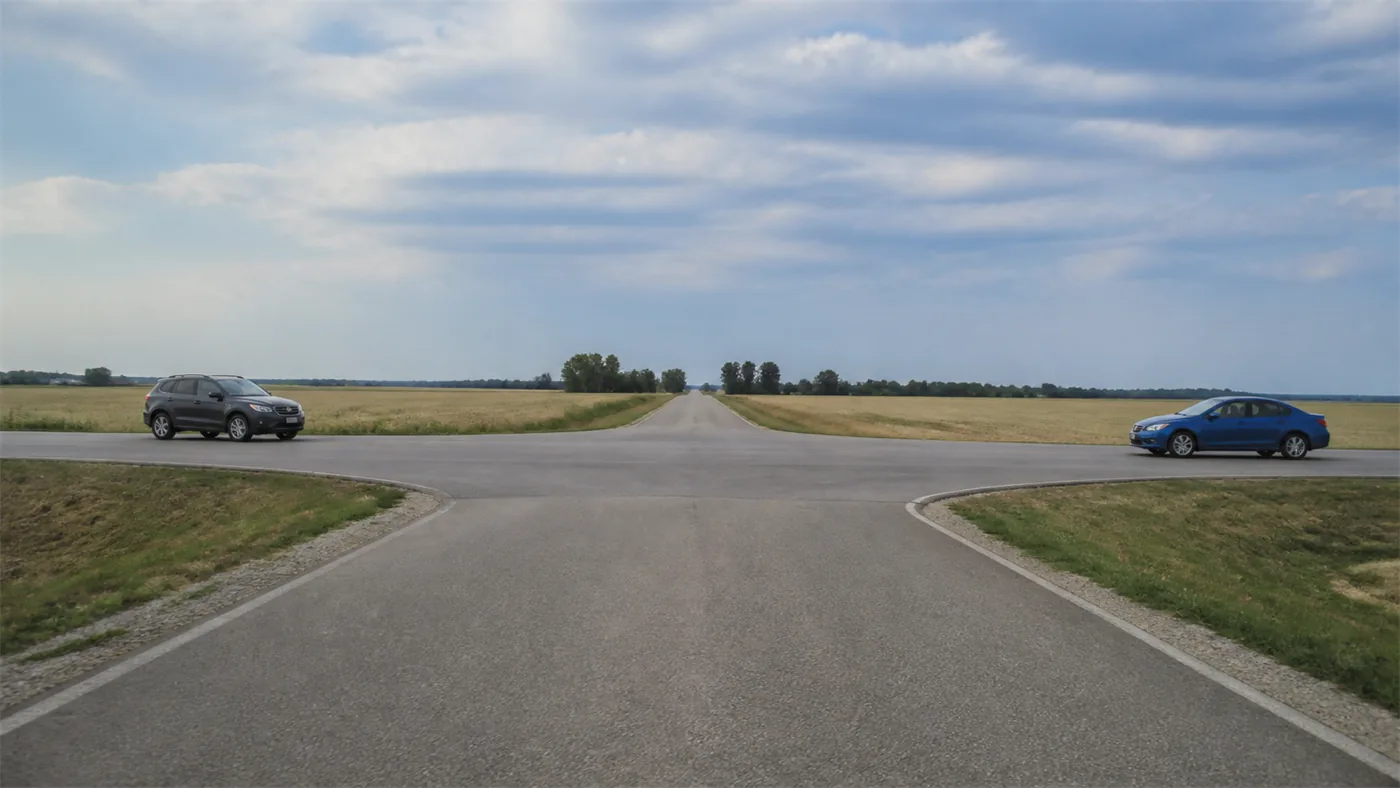
Plenty of residential corners have no stop sign, no yield sign and no signal in any direction. These are uncontrolled intersections, and they come up on the test constantly because the rule is easy to state and easy to forget. The driver who arrives first goes first. When two drivers arrive together, the driver on the left yields to the driver on the right.
Picture it from the seat. You reach the corner and a car appears on your right at the same moment. You yield. If the car appears on your left instead, the other driver is the one expected to wait, but you still cover the brake and watch their front wheels until you can see the car slowing. Front wheels tell you what a car is doing a moment before the body of the car does.
Treat every uncontrolled intersection as though it is blind, because many of them are. Slow enough that you could stop, look left, then right, then left again, and check both sidewalks before you cross. Parked cars, hedges and piled snow hide a small car completely, and a hidden car turns a simple rule into a guess.
An intersection with no signs or lights
Your vehicle
Another vehicle
Where it goes
Whoever arrives clearly first goes first, and when two drivers arrive together the one on the right goes.
Four way stops
A four way stop resolves by order of arrival. Every driver stops completely behind the line, and then drivers go in the order they stopped. If you were third to arrive, you are third to go, no matter how large your vehicle is or how much of a hurry anyone is in.
Two drivers who arrive together fall back on the same tie breaker as an uncontrolled corner: yield to the driver on your right. When the two drivers who arrive together are facing each other and one of them is turning left, the driver going straight goes first, because the left turn crosses the path of the oncoming vehicle.
A complete stop means the wheels stop turning. Rolling through at walking pace is the most common fault here, and it costs more than a mark on a road test. It destroys the order of arrival, because none of the other three drivers can tell whether your turn has begun. Stop, look at the other drivers, then go.
Who goes first at a four way stop
Your vehicle
Another vehicle
Where it goes
The first driver to stop goes first, and drivers who stop together yield to the car on their own right.
Turning, joining and leaving the road
Turning left across oncoming traffic means yielding to everything coming toward you, cyclists included, and then to anyone crossing the road you are turning into. The oncoming driver has no duty to slow down for you and usually cannot tell what you intend until your car starts to move.
Anyone joining a road from a driveway, a lane, an alley, a parking lot or a private road yields to the traffic already on that road. You also yield to people on the sidewalk you are about to cross. The rule is about the kind of place you are coming from, not about how busy the road looks.
Where one road ends at another and forms a T, the traffic on the road that continues has the right of way. The driver on the road that ends yields, whether they plan to turn left or right. Watch for this one on the test, because a T with no signs on it still has a clear answer.
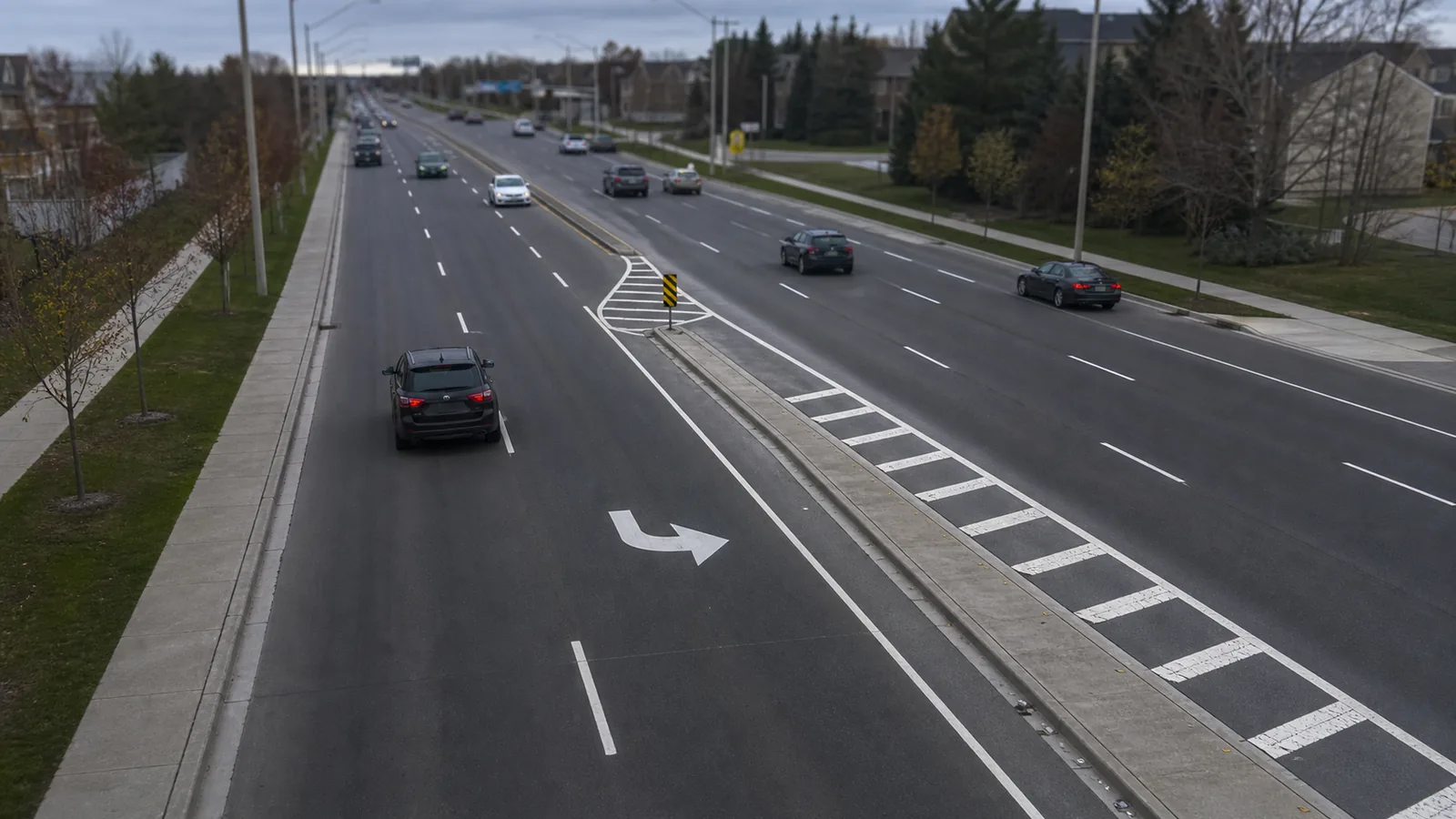
A marked left turn bay and a painted island, seen from above. Most of what a knowledge test asks about is painted on the road rather than posted beside it.
People on foot, and the vehicles everyone yields to
Pedestrians in a crosswalk are yielded to, and a crossing exists at a corner where the sidewalks line up even when nobody has painted lines on the road. Someone who has already started to cross keeps the right of way until they reach the far side, including when the light changes while they are still out there. Cutting behind them is the reflex to unlearn.
Emergency vehicles running lights and siren are yielded to by everyone. Pull to the right where it is safe, stop, and wait for them to pass. School buses with red lights flashing stop traffic on the road. Both belong to the lesson on sharing the road, but the test also treats them as right of way rules, so learn them in both places.
What a green light does and does not give you
A green light gives you priority over the roads facing a red, and nothing beyond that. It does not clear the intersection of the driver who entered on the amber, the cyclist still crossing, or the pedestrian who is halfway over. Look into the intersection before you enter it, not just at the light hanging above it.
One more rule holds everywhere in Canada and is worth carrying into every intersection: do not enter unless there is room for your vehicle on the far side. Stopping in the middle turns a working intersection into a jam and leaves you parked across a green light that belongs to somebody else.
Alberta and this topic
Alberta
Alberta follows the same rules on this topic
Nothing above changes when you cross into Alberta, so there is no separate Alberta version of this lesson to read. The stages, the fees and the format of the test are the numbers that do change, and those sit on the Alberta page with the source behind each one.
The 6 practice questions on this topic in the Alberta bank are written for Alberta, and each one shows the authority it comes from when you answer it.
Size decides nothing. Order of arrival decides, and a tie goes to the driver on the right. A truck driver who waves you through is being courteous, not applying a rule, and you are still responsible for checking that the way is clear before you accept.
What people think
I had the right of way, so the crash was not on me.
What is actually true
Right of way sets the expected order. It does not remove the duty to avoid a collision you could reasonably have avoided, and insurers and courts both look at what you did after the other driver made the mistake.
What people think
A rolling stop counts when the intersection is empty.
What is actually true
It is not a stop, and at a four way stop it also breaks the system, because the other drivers cannot see when your turn began. The habit tends to show up again under pressure on a road test.
What people think
Once my light turns green the intersection belongs to me.
What is actually true
Green gives you priority over the crossing roads only. Anyone already inside the intersection, on wheels or on foot, clears it first.
What people think
A pedestrian only has the right of way where there is paint on the road.
What is actually true
Crossings exist at corners whether or not they are marked. Painted lines make a crossing obvious; they do not create the right to be there.
Check yourself
Three questions from the Alberta bank on right of way. Answer them in your head first, then open the answer to see the rule it comes from.
Right of way1 of 3
You come to a residential intersection with no stop signs, no yield signs and no lights in any direction. A car reaches it from your left at the same moment you do. What should you do?
AGo ahead, since the driver on your left has to yield to you, but stay ready to stop if they keep coming
BStop and wave the other driver through, because you got there together
CSound your horn and take the intersection before they do
DWait until the intersection is completely empty in every direction
Show the answer
The answer is A. Go ahead, since the driver on your left has to yield to you, but stay ready to stop if they keep coming
At an intersection with no signs or lights, the driver on the left yields to the driver on the right, so the right of way is yours. Right of way is something another driver gives you rather than something you can take, so keep watching them until you are sure they are slowing.
Alberta Driver's Guide (Government of Alberta)
Right of way2 of 3
You are stopped inside the intersection waiting for a gap to turn left on a green light. The light goes amber and then red while oncoming traffic is still clearing. What do you do?
AReverse back behind the stop line
BComplete the turn once the oncoming vehicles have stopped, then clear the intersection
CStay where you are until the light turns green again
DTurn at once, because a red light for you is a red light for them
Show the answer
The answer is B. Complete the turn once the oncoming vehicles have stopped, then clear the intersection
Once your wheels are past the stop line you are committed, and the intersection has to be cleared. Wait for the oncoming traffic to actually stop, then finish the turn. Backing up puts you into vehicles you cannot see, and sitting there blocks the drivers who now have a green.
Alberta Driver's Guide (Government of Alberta)
Right of way3 of 3
You are partway through a large intersection when you hear a siren and see an ambulance with its lights on coming up behind you. What is the right move?
ACarry on out of the intersection, then pull to the right and stop clear of it
BStop where you are so the ambulance can pick its own way around
CSpeed up and stay ahead of it until it turns off
DPull to the left, because the ambulance will use the right shoulder
Show the answer
The answer is A. Carry on out of the intersection, then pull to the right and stop clear of it
Stopping inside an intersection blocks the one piece of road the emergency crew needs most. Clear the intersection first, then move right and stop, and stay stopped until it has passed. Everyone pulling right every time is what makes the gap predictable.
Alberta Driver's Guide (Government of Alberta)
Now go and answer some questions
The Alberta bank holds 6 questions on right of way. Answering them now, while the lesson is fresh, is how you find the parts that only felt clear.
We use Google Analytics and Microsoft Clarity to see which pages help learners, and advertising cookies to keep the site free to use. Accept to allow them, or decline. How your data is handled