Quebec asks about licensing and the graduated system in 5 of our questions, and has 2 rules here that differ from the national ones. Every province licenses new drivers in stages, and the stages exist for the same reason everywhere. This explains the shape of the system and the kind of restriction each stage carries. The dates, ages, fees and hold times live on your province page.
About 7 minutes to read5 Quebec questions on thisLast reviewed 2026-08-27
Worth remembering
Licensing is provincial. There is no national driving test in Canada.
Graduated licensing exists because crash risk is highest in the first months of driving alone.
Stage one is a knowledge test, then supervised driving with restrictions and a minimum hold period.
Stage two follows a road test: you drive alone, but conditions such as zero alcohol and passenger or night limits continue.
Approved driver education shortens the wait in several provinces, and Quebec requires an approved course.
Breaking a stage condition can mean suspension, a longer stage or a return to an earlier one.
A full licence comes after a second, harder road test, and other vehicle classes need their own tests.
Ages, hold times, fees, restrictions and exchange rules are provincial. Use your province page for all of them.
Why licensing happens in stages
Crash risk for a new driver is highest in the first months of driving alone and falls steadily with experience. Graduated licensing is built around that fact. Instead of one test that turns a learner into a fully licensed driver overnight, the system lets you build experience in conditions that are easier to survive, and removes the restrictions as you prove you can drive without them.
That is why the restrictions look the way they do. They target the situations that hurt inexperienced drivers most: driving alone before the basics are automatic, driving at night, carrying a car full of other young passengers, alcohol, and high speed roads. Every jurisdiction in Canada uses some version of this, though the details vary from one to the next.
Licensing is provincial. There is no national driving test and no federal licence. Each province and territory sets its own stages, its own names for them, its own minimum ages, its own hold periods and its own fees. That is why this lesson teaches the shape of the system rather than the numbers: for the figures that apply to you, use the page for your own province.
Stage one: the learner licence
The first stage begins with a knowledge test, usually taken at a licensing office or an authorised agent, covering road signs and the rules of the road. This is the test our practice runs are built for. Most places pair it with a vision screening, and some ask for identity documents and proof that you live in the province, so check what to bring before you go.
Passing gives you a learner licence, and with it a set of restrictions that are broadly similar across the country: you drive only with a qualified supervising driver beside you, that person must hold a full licence and meet conditions the province sets, there is no alcohol in your system, everyone wears a seatbelt, and there are limits on when and where you may drive. Restrictions on driving late at night, on certain high speed highways, or with more passengers than there are seatbelts are common at this stage.
The learner stage also has a minimum hold period, so you cannot rush from the knowledge test to a road test in a week. Several provinces shorten that hold period if you complete an approved driver education course, and Quebec goes further than the rest of the country by requiring an approved course before you can be licensed at all. The length of the hold and the size of any reduction are provincial figures.
Stage two: driving alone with conditions
A road test moves you into the second stage. Now you drive without a supervisor, which is the whole point, but conditions remain. The zero alcohol rule almost always continues. Limits on the number of young passengers you may carry, and on driving in the small hours of the morning, are common. Some provinces keep a restriction on certain highways at this stage, and some require a marker on the vehicle showing that a new driver is at the wheel.
The second stage also lasts a set minimum time, and again a recognised driver education course can shorten it in some provinces. Collect real experience during it rather than just waiting the period out: night driving, rain, snow, gravel, highways, city traffic and parking in awkward places are the things a second road test looks for and the things a first winter will demand of you anyway.
Breaking a condition of your stage is more serious than it sounds. Depending on the province it can mean a suspension, an extension of the time you must spend at that stage, or a return to an earlier stage. That is one of the reasons the restrictions are worth reading carefully rather than assumed from what a friend in another province told you.
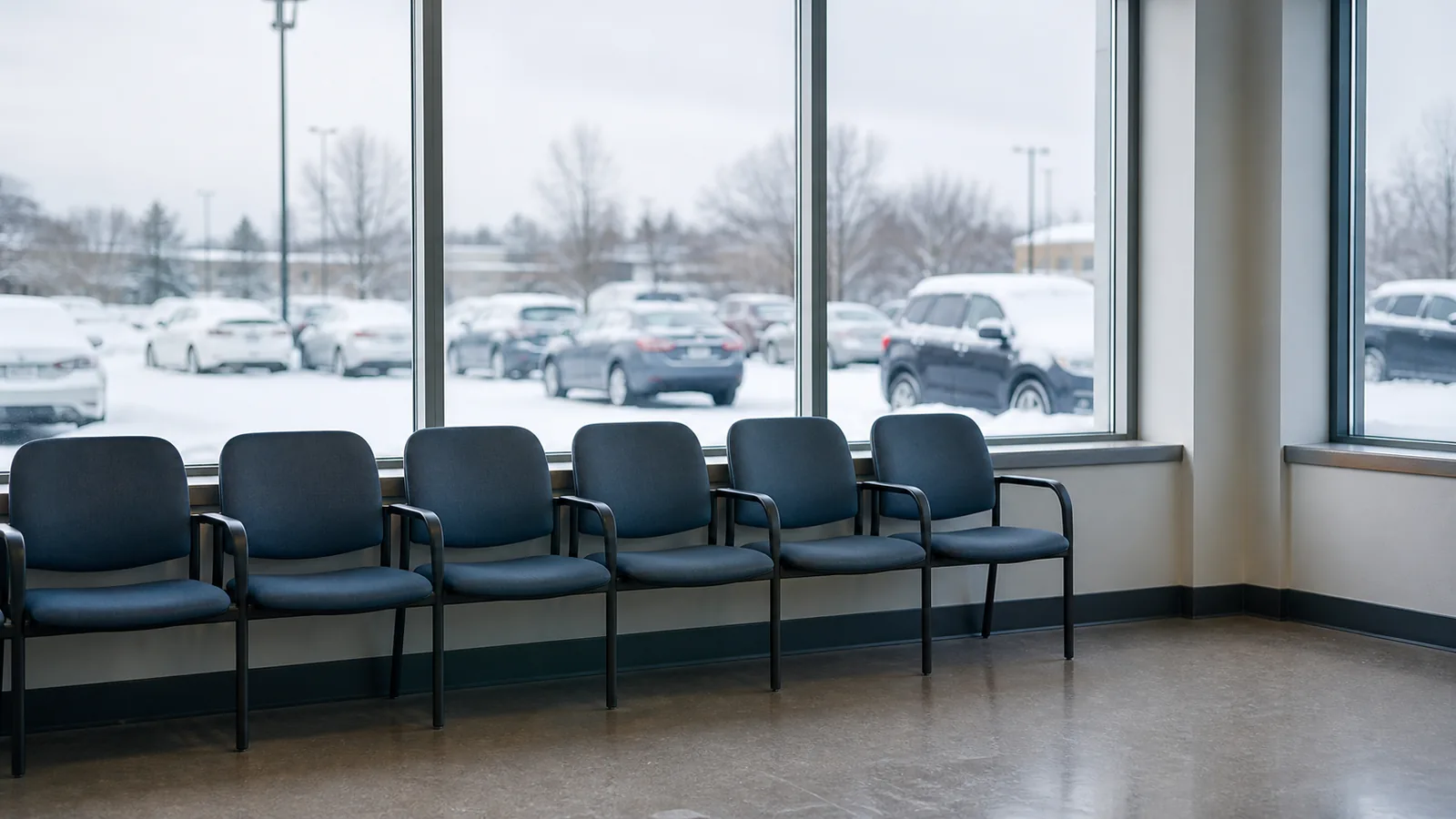
A waiting area at a public service office. The sitting itself is short. The paperwork around it is what takes the morning.
The full licence, and keeping it
In most provinces a second road test, taken on more demanding roads than the first, ends the graduated stages and gives you a full licence for ordinary passenger vehicles. This is one of the parts that varies and that is being changed, so check what your own province asks for rather than assuming a second test is waiting. Other classes, for motorcycles, larger trucks, buses and vehicles carrying passengers for hire, have their own tests and their own requirements, and holding a car licence is not the same as being licensed for those.
A full licence still comes with duties: renewing it on time, keeping the address on it current, carrying it while you drive, and meeting any medical reporting requirement your province sets. Drivers who accumulate penalties can be returned to restrictions or lose the licence entirely, which is covered in the lesson on documents and penalties.
If you already hold a licence from another country or another province, you may not need to start at the beginning. Provinces have exchange arrangements with some places, and credit arrangements for driving experience from others, so the stage you enter depends on where your licence is from and how long you have held it. That is a question for your provincial licensing body, and the answer is different in every province.
Preparing for the knowledge test itself
Formats differ. The number of questions, the pass mark, whether the exam is split into sections that must each be passed on their own, the time limit, whether the screen ends the session early once the result is decided, the fee and the wait before a retake are all set by the province, and some of those mechanics genuinely change how you should pace yourself. Our practice runs mirror the format for each province so that nothing on the day is a surprise.
The content, though, is the same subject matter everywhere: signs, right of way, intersections, speed and space, passing, parking, sharing the road, impairment, emergencies and the paperwork that goes with a vehicle. That is what the rest of these lessons cover. Read the guide published by your own province alongside them, because it is the document the exam is written from, and it is free.
What Quebec does differently
Everything above holds across Canada. This part does not, and it is the part a Quebec examiner can ask about.
Quebec rule
The course comes first
In every other province driver education is optional and usually rewarded with a shorter wait. In Quebec it is the entrance. You enrol with a school recognised by the province, and the course runs in phases that mix classroom sessions with sessions behind the wheel, spread out on purpose so that practice happens between lessons instead of being crammed before a test.
The learner licence arrives early in the course rather than at the end of it, so you are driving with an accompanying driver while the lessons carry on. That accompanying driver has to hold a valid licence of the right class and to have held it for the period the SAAQ sets, and they sit in the front passenger seat. You must have no alcohol in your system, and demerit points count against a lower threshold than the one full licence holders live with.
The knowledge test only opens once you have held the learner licence for the period shown on this page. That wait is part of the design rather than a booking problem, so there is nothing to escalate and nobody to ask for an exception. Drivers who were licensed elsewhere in Canada find this the hardest part of Quebec to accept, and it is the single fact worth telling a newcomer before they make plans around a licence date.
The probationary licence follows the road test. Zero alcohol continues for the whole of that stage, and the lower demerit threshold continues with it. The SAAQ publishes both the thresholds and the length of each stage, and it is the only place worth reading them.
The exam is split into parts, and each part carries its own pass requirement. Clearing the exam means clearing every part rather than reaching one overall total, unlike the single score used in British Columbia and Alberta.
Fail one part and you wait before you may attempt it again. The length of that wait is on this page, and it is long enough to reshape a plan, so the material you find hardest deserves the most preparation rather than the least. Work out where you are weakest before you book, not after.
We do not print a question count or a pass mark for this exam, because we have not sourced those figures from the SAAQ itself and we would rather leave a gap than fill it with something from a forum. Everything we do show carries its source and the date we checked it. For the rest, ask the SAAQ, and confirm the current format when you book, since the format is theirs to change.
The fee is on this page, and it is the smallest knowledge test fee among the four provinces we cover in depth. That is a small mercy in a process that has already put you through a mandatory course.
A Canadian driving licence works the same way in every province.
What is actually true
The stages, ages, hold periods, restrictions and fees are set by each province and territory. Moving across a border means checking the rules again, including what your current licence counts for.
What people think
Once I pass the knowledge test I can book a road test right away.
What is actually true
Each province sets a minimum time you must hold the learner stage. Driver education shortens it in some places, but it does not remove it.
What people think
The restrictions on a new licence are advice rather than law.
What is actually true
They are conditions of the licence itself. Breaking one can suspend you, extend your time at that stage or send you back a stage, on top of the ordinary penalty for the offence.
What people think
Driver education is only about passing the test.
What is actually true
In several provinces it also shortens the required wait between stages, and in Quebec an approved course is required before licensing. The value differs by province, so check what yours offers.
What people think
My licence from another country will be swapped over automatically.
What is actually true
It depends on where it is from, how long you have held it, and which province you are moving to. Some licences are exchanged, some earn credit toward experience, and some need the full process.
Check yourself
Three questions from the Quebec bank on licensing and the graduated system. Answer them in your head first, then open the answer to see the rule it comes from.
Licensing and the graduated system1 of 3
A newcomer to Quebec with no driving experience asks whether they can just study at home and book the tests.
AYes, studying at home is enough if they pass both tests
BYes, but only after holding a learner's licence for a year
CNo, Quebec requires a recognised driving course, and that is where the process starts
DNo, but the course is required only for drivers under a certain age
Show the answer
The answer is C. No, Quebec requires a recognised driving course, and that is where the process starts
Quebec is the province that made a government approved driving course compulsory for new drivers, so enrolling in one is the first step rather than an optional extra. The course runs in stages that mix classroom work with time behind the wheel, and progress through the licensing stages depends on finishing them. Studying alone does not open the door to the tests here.
Highway Safety Code (Quebec)
Licensing and the graduated system2 of 3
You hold a learner's licence, and a friend who passed their own road test a few months ago offers to sit beside you while you practise.
ANo, the person accompanying you must have held a valid licence for longer than that
BYes, any fully licensed driver may accompany you
CYes, as long as they sit in the front passenger seat
DYes, provided you stay on quiet streets
Show the answer
The answer is A. No, the person accompanying you must have held a valid licence for longer than that
The person beside a learner has to be experienced enough to read a situation early and talk you out of it, so the law sets a minimum time they must have been licensed. A driver who is nearly new themselves cannot do that job. They also have to sit in the front passenger seat, sober and able to take over.
Highway Safety Code (Quebec)
Licensing and the graduated system3 of 3
You have passed the knowledge test and want to book the road test as soon as you can.
AYou may book it whenever you feel ready, since the knowledge test was the gate
BYou must finish the driving course and hold the learner's licence for the required period first
CYou may book it once you have completed the in car sessions of the course
DYou may book it once you have driven a set number of hours with someone supervising
Show the answer
The answer is B. You must finish the driving course and hold the learner's licence for the required period first
The road test sits at the end of two clocks: the driving course has to be finished, and the learner stage has to have been held for the period the rules set. Neither is shortened by feeling ready, because the point of the wait is time on the road in different conditions and seasons. Book once both are satisfied.
Highway Safety Code (Quebec)
Now go and answer some questions
The Quebec bank holds 5 questions on licensing and the graduated system. Answering them now, while the lesson is fresh, is how you find the parts that only felt clear.
We use Google Analytics and Microsoft Clarity to see which pages help learners, and advertising cookies to keep the site free to use. Accept to allow them, or decline. How your data is handled