Quebec asks about intersections and turns in 5 of our questions, and has 1 rule here that differs from the national ones. Most collisions happen where paths cross. This is how to read an intersection on the way in, make a left turn across traffic without guessing, and get through a roundabout in the right lane.
About 7 minutes to read5 Quebec questions on this2 diagramsLast reviewed 2026-08-27
Worth remembering
Decide your lane and your plan before the intersection; the last few car lengths are for looking.
Scan left, right, then left again, because the closest oncoming traffic is on your left.
Amber means stop unless stopping is unsafe. Decide your answer while the light is still green.
Waiting to turn left, keep your wheels straight so a rear hit does not push you into oncoming traffic.
Judge a left turn gap by whether you can finish and clear their path, not by how far away the car looks.
Check your right mirror and blind spot for cyclists before every right turn.
Entering a roundabout, yield to traffic already circulating, pick the lane before you enter, and signal right on the way out.
Right turns on red and flashing green lights are two rules that differ by province. Check the guide for yours.
Read the intersection before you reach it
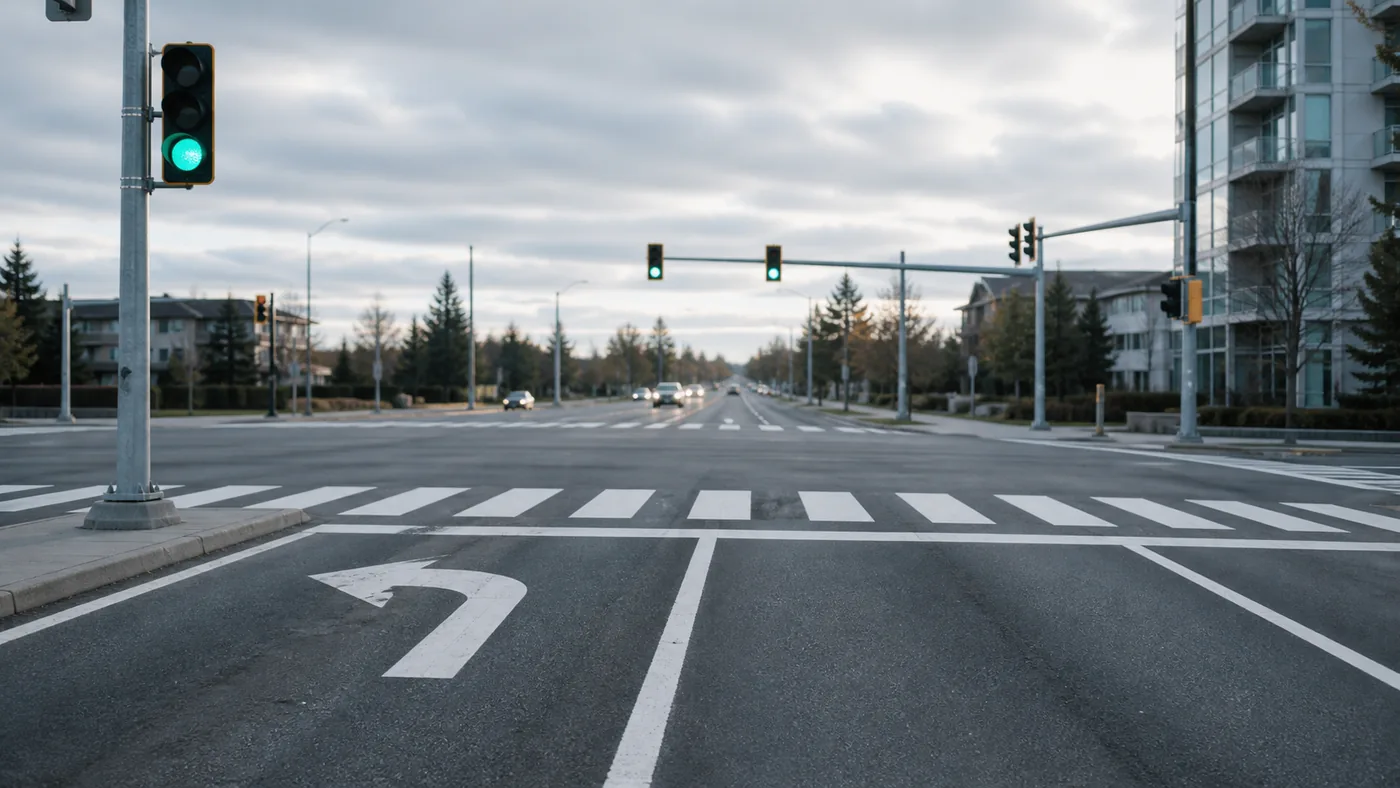
Every intersection tells you how it works before you arrive, if you look for the right things. Is it controlled by a signal, by signs, or by nothing at all? Which lane are you in, and what do the arrows painted on that lane allow? Is there a crosswalk, and is anyone standing at the curb waiting to use it? Are the vehicles ahead of you slowing for a reason you cannot see yet?
Get that reading done early, because the last few car lengths are for looking, not for deciding. Ease off the accelerator, cover the brake, and scan left, then right, then left again as you approach. The second look to the left matters because the traffic nearest to you on a two way road comes from your left, and a lot can change in the seconds it takes to check the other side.
Choose your lane well before the intersection rather than at it. Changing lanes inside an intersection is a fault on a road test in every province, and on a real road it puts you beside a driver who has no reason to expect you.
Signals, and the moment the light turns amber
A steady amber light means stop, unless you are already so close that stopping would be unsafe or would put you into the middle of the intersection. It does not mean hurry. The habit worth building is to decide as you approach any green light how you would respond if it changed, so the answer is ready before you need it. A green light that has been green since you first saw it is one that is due to change.
A green arrow protects the movement it points at, which means the traffic that would otherwise conflict with you is being held. A round green does not protect a left turn, so you must find your own gap. A red light means a full stop behind the line, and it stays a red light while you wait for that gap on an amber, so never edge over the line on red.
Two signal details differ across the country and are worth checking in the guide for your province. Right turns on a red light are allowed in most of Canada after a complete stop and a proper look, but not everywhere, and never where a sign forbids it. A flashing green light does not mean the same thing in every province: in some places it protects a turn, and in others it marks a crossing where people on foot control the signal. Being wrong about that one is dangerous, so look it up rather than assume.
The left turn across traffic
The unprotected left turn is the hardest ordinary thing a new driver does, and it is where a large share of serious intersection crashes happen. You signal early, move into the correct lane, and pull forward into the intersection when the way is clear enough to be there, keeping your front wheels pointed straight ahead. Straight wheels matter: if a vehicle hits you from behind while you wait, you are pushed forward rather than into oncoming traffic.
Then you judge the gap. The question is not whether the oncoming car is far away. It is whether you can finish the turn and be clear of their path before they reach you, at the speed they are actually travelling. Look past the first vehicle for a second one following close behind, and look through the intersection for someone coming the other way who also wants to turn left, because two left turning cars can hide each other completely.
Finish the turn by yielding to anyone crossing the road you are entering. Drivers concentrating on the gap in traffic often complete a good turn straight into a pedestrian who has had a walk signal the whole time. If the light turns red while you are waiting in the intersection, you still complete the turn when the oncoming traffic stops, because you are already committed and legally in the intersection.
Turning left across oncoming traffic
Your vehicle
Another vehicle
Where it goes
Wait inside the intersection with the front wheels straight until the gap is long enough to finish the turn.
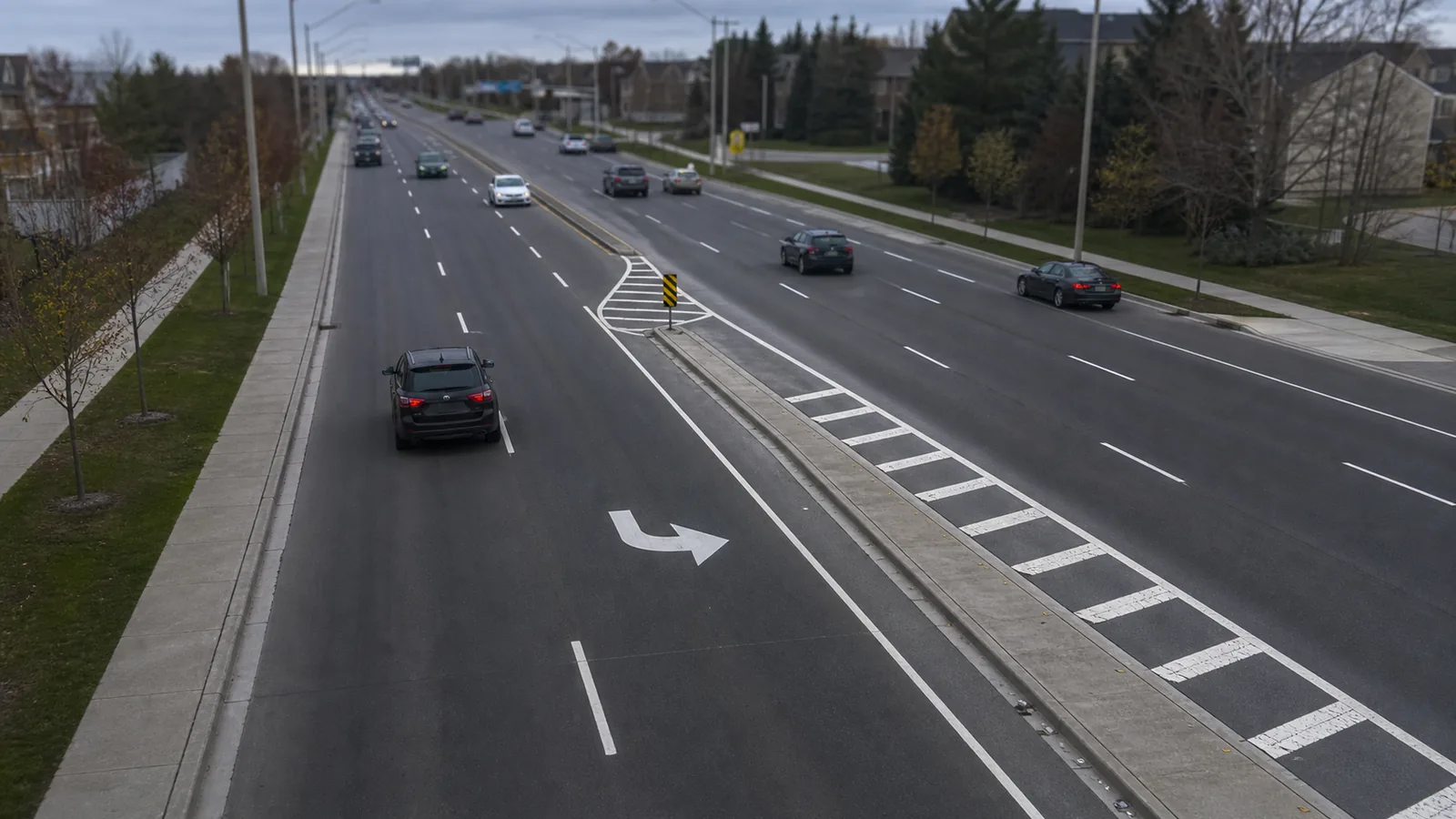
A marked left turn bay and a painted island, seen from above. Most of what a knowledge test asks about is painted on the road rather than posted beside it.
Right turns, and the corner you cannot see
A right turn looks simple and hides two problems. The first is the cyclist or the scooter coming up on your right, in a bike lane or in the gap between you and the curb. Signal early, check your right mirror and your blind spot before you begin the turn, and do not cut across a marked bike lane where the paint tells you to yield instead.
The second is the pedestrian stepping off the corner you are turning into, often walking toward you and out of the line of sight your windshield pillar leaves you. Turn your head. Keep the turn tight enough to stay in your own lane and end in the nearest lane going your direction, unless markings say otherwise.
Roundabouts
Traffic in a Canadian roundabout moves counter clockwise, and everyone entering yields to traffic already going around. That single rule solves most of it. Slow down on approach, look to your left, and enter when there is a gap. Never stop inside the circle once you are moving, and never try to pass another vehicle in there.
Lane choice is the part learners get wrong. Choose your lane before you enter, based on the signs and arrows on the approach, not on where you happen to be. As a general pattern, the right lane serves the first exits and going straight through, and the left lane serves the later exits and turning back the way you came, but the markings on the ground govern and multi lane roundabouts vary. Signal right as you pass the exit before the one you want, and do not signal left on the way in unless the markings ask for it.
Large trucks need the whole width of the circle and sometimes ride up onto the paved apron around the island, so give them space rather than tucking in beside them. Cyclists may take the full lane in a roundabout, which is the safest thing for them to do. People on foot cross at the marked crossings on each approach, outside the circle, and they are yielded to on the way in and on the way out.
Choosing a lane at a roundabout
Your vehicle
Another vehicle
Where it goes
Traffic runs counter clockwise around the island, and you pick your lane on the approach rather than inside the circle.
What Quebec does differently
Everything above holds across Canada. This part does not, and it is the part a Quebec examiner can ask about.
Quebec rule
Right turn on red, except on the island of Montreal
Across most of Quebec a right turn on a red light is allowed after a complete stop, unless a sign prohibits it. On the island of Montreal it is prohibited everywhere, on every street, at every hour, and no sign is needed to make that true. The island is the exception; the rest of the province follows the ordinary rule.
The catch is the boundary. Drive off the island toward Laval or the south shore and the permission switches on underneath you. Drive back and it switches off. Signs are posted where you cross, but the responsibility is yours, and a driver who learned the habit downtown will sit at a red light in Longueuil wondering why the car behind is unhappy.
Where the turn is allowed, the sequence matters. Come to a complete stop at the line. Look for a sign that forbids the turn, because those are common near schools and busy crossings. Then yield to pedestrians crossing with their signal, to cyclists coming up on your right, and to traffic already in the intersection. Moving into the crossing while somebody is walking in it is an offence whoever had the light.
Learn this as two facts rather than one: prohibited on the island, permitted elsewhere unless a sign says otherwise. It is the question newcomers to Quebec ask most often, and it appears in the knowledge material.
Where people get this wrong
What people think
Amber means speed up and get through.
What is actually true
Amber is a warning that red is coming, and the legal instruction is to stop when you can do so safely. Accelerating into a changing light is how drivers meet the person who started early on the other side.
What people think
Turning my wheels left while I wait saves time.
What is actually true
It also aims you at oncoming traffic. If anyone hits you from behind while you wait, straight wheels send you forward into a gap and turned wheels send you into the vehicles you were waiting for.
What people think
A green light means I can turn left whenever there is a gap.
What is actually true
A round green lets you enter the intersection to wait, and you still yield to oncoming traffic and to people crossing the road you are turning into. Only a green arrow protects the turn.
What people think
In a roundabout you can change lanes to reach your exit.
What is actually true
Lane choice happens on the approach. Once you are in the circle, changing lanes cuts across a driver whose exit you are crossing, which is the collision roundabouts otherwise avoid.
What people think
I am stuck in the intersection on a red, so I have to reverse or sit there.
What is actually true
If you entered legally to make a left turn and the light changed, complete the turn once oncoming traffic has stopped. Never reverse in an intersection.
Check yourself
Three questions from the Quebec bank on intersections and turns. Answer them in your head first, then open the answer to see the rule it comes from.
Intersections and turns1 of 3
You are stopped at a red light in Montreal and want to turn right. Nothing is coming, no one is waiting to cross, and there is no sign at the corner about turning.
ATurn after a complete stop, since no sign forbids it
BTurn only if the crossing traffic is held by its own red light
CWait for the green light, because right turns on red are not allowed on the island of Montreal
DTurn after a complete stop, because the ban applies only in the downtown core
Show the answer
The answer is C. Wait for the green light, because right turns on red are not allowed on the island of Montreal
Right on red is permitted in most of Quebec but nowhere on the island of Montreal, and the ban holds whether or not a sign says so. Drivers who learned elsewhere in the province are the ones who get caught, because they are used to treating the red as a stop sign. On the island you wait for the green every time.
Highway Safety Code (Quebec)
Intersections and turns2 of 3
You are driving in Quebec City and want to turn right at a red light. There is no sign prohibiting the turn.
AStop completely first, then turn once pedestrians and crossing traffic are clear
BSlow to walking pace and turn if nothing is coming
CTurn without stopping if the crossing street is empty
DWait for green, because the turn is only allowed on a green arrow
Show the answer
The answer is A. Stop completely first, then turn once pedestrians and crossing traffic are clear
Outside the island of Montreal a right turn on red is allowed unless a sign forbids it, but only after a complete stop. You then give way to people crossing with the walk signal and to any vehicle already in the intersection. The turn is a permission, not a right of way, so everything already there goes first.
Highway Safety Code (Quebec)
Intersections and turns3 of 3
You are approaching a roundabout with two lanes and your exit is the third one, most of the way around.
AEnter in the right lane and stay in it all the way around
BEnter in whichever lane is free and change lanes inside as your exit comes up
CStop at the entry line and wait until the roundabout is completely empty
DPick the correct lane before you enter, hold it round, and signal right after passing the exit before yours
Show the answer
The answer is D. Pick the correct lane before you enter, hold it round, and signal right after passing the exit before yours
Lane choice at a roundabout is made before you enter, because changing lanes inside one cuts across a driver who is already committed to a line. The left lane normally serves the far exits and the right lane the early ones, so read the markings and signs on the approach. You give way to traffic already going round, but you never have to wait for an empty roundabout.
Highway Safety Code (Quebec)
Now go and answer some questions
The Quebec bank holds 5 questions on intersections and turns. Answering them now, while the lesson is fresh, is how you find the parts that only felt clear.
We use Google Analytics and Microsoft Clarity to see which pages help learners, and advertising cookies to keep the site free to use. Accept to allow them, or decline. How your data is handled